2. Faculty Resources

Faculty orientation deck · draft / consultation marks
50score (Autonomous)
6/3metrics (Autonomous)
Inputcategory

Criterion 2

Criterion 2 | Faculty Resources

Understanding the metrics · Preparing the institution

Meaning • Documents • Responsibilities • Measurement
6 baseline metrics + 1 supplementary topics

Orientation to the proposed ten-attribute reform framework. Consultation/draft marks are not final official scoring rules.

Faculty orientation edition • 23 October 2026

Metric 2.1 | Recruitment

Not established in the Draft, In summary 25

Demonstrate planned, transparent recruitment and adequate staffing against approved posts. Distinguish permanent, contract, visiting and other appointments.

Documents to prepare and maintain

  • Sanctioned-post statement.
  • recruitment and selection records.
  • appointment and joining orders.

Who is responsible?

  • Principal and management/appointing authority.
  • HR/Establishment Office.
  • HoDs.

Faculty sourcing practices includes:

  1. Short listing based on ORDINANCES of Central/ State/ other Universities
  2. List of candidates shortlisted posted on website of the institution
  3. Provision of appeal against short listing
  4. Selection committees constituted as per UGC regulation 2018
  5. Roster followed for selection of teachers
  6. Selection based on Academic Score/Written Test/Personal Interview
  7. Required No. of teaching position as per regulatory body and Filled UpPosts of Faculty
  8. Selection process for faculty transparent and open
Recruitment | measurement, weightage and interpretation

How the metric is understood or measured

Compare sanctioned and filled posts by cadre and discipline. Do not treat visiting appointments as permanent posts.

Draft weightage / source maximum

Not established in the Draft, In summary 25

Strategic planning & Discussion

Orientation exercise: use real institutional details and show the primary record, the supporting evidence and the relevant approval or review.

Do not treat the number of documents, photographs or activities as an automatic assessment score.

Metric 2.2 | Pay and Allowances

Not established in the Draft, In summary 25

Explain the institution's approved remuneration arrangements and whether payments are implemented consistently. Keep individual salary records confidential.

Documents to prepare and maintain

  • Approved pay and allowance policy.
  • appointment terms.
  • certified payroll and payment reconciliation.

Who is responsible?

  • Finance Officer and HR/Establishment Office.
  • Principal.
  • management.

Whether the pay and allowances are as per UGC/AICTE norms:

Pay and Allowances | measurement, weightage and interpretation

How the metric is understood or measured

Reconcile approved entitlements, payroll and actual payments; report aggregate evidence rather than personal bank details.

Draft weightage / source maximum

Not established in the Draft, In summary 25

No autonomous metric-specific allocation available

Not a verified final allocation or score-conversion rule.

Strategic planning & Discussion

Orientation exercise: use one real institutional example and show the primary record, the supporting evidence and the relevant approval or review.

Do not treat the number of documents, photographs or activities as an automatic assessment score.

Metric 2.3 | Faculty Diversity

Not established in the Draft, In summary 25

Describe the range of faculty backgrounds and expertise represented in the institution. Collect only necessary and authorised personal information.

Documents to prepare and maintain

  • Verified faculty profiles.
  • recruitment/diversity policy where adopted.
  • aggregate faculty-composition statement.

Who is responsible?

  • HR/Establishment Office and HoDs.
  • Principal.
  • relevant equality/inclusion committee.

Ratio of teachers with gender and geographic diversity to the total number of teachers

Faculty Diversity | measurement, weightage and interpretation

How the metric is understood or measured

Use a clearly stated population and reporting date,

Draft weightage / source maximum

Not established in the Draft, In summary 25

No reliable autonomous metric-specific allocation available

Not a verified final allocation or score-conversion rule.

Strategic planning & Discussion

Orientation exercise: use real institutional data and show the primary record, the supporting evidence and the relevant approval or review.

Do not treat the number of documents, photographs or activities as an automatic assessment score.

Metric 2.4 | Faculty Development

No draft weightage given

Support teachers in updating subject knowledge, teaching methods, assessment and professional skills. Show how learning is applied after training.

Documents to prepare and maintain

  • FDP/training calendar and sanction orders.
  • attendance and completion certificates.
  • Certified list of faculties attended training programs with details.-Certified/e-copies of the certificates of completion for faculty sponsored towards industrial training, fellowships, etc

Who is responsible?

  • Faculty Development Committee and IQAC.
  • HoDs.
  • individual faculty members.

Percentage of faculty attended training programs (AICTE, UGC, ARPIT and similar), faculty sponsored for industrial training, fellowships etc.

  • Number of full-time teachers attended orientation program/faculty development programmes and/or refresher courses
  • Number of faculty members sponsored for industrial training (minimum two months), fellowships, etc. during last three years.

Faculty Development | measurement, weightage and interpretation

How the metric is understood or measured

Unique eligible teachers completing training ÷ eligible full-time teachers × 100 is an orientation indicator; official duration and eligibility rules require confirmation.

Draft weightage / source maximum

No reliable autonomous metric-specific allocation available

Not a verified final allocation or score-conversion rule.

Strategic planning & Discussion

Orientation exercise: use real institutional data and show the primary record, the supporting evidence and the relevant approval or review.

Do not treat the number of documents, photographs or activities as an automatic assessment score.

Metric 2.5 | Faculty Retention

Not established in the Draft. May be included in 15 or as 7.1

Examine continuity of the teaching workforce and the reasons staff leave. Separate retention of an existing cohort from newly recruited staff.

Documents to prepare and maintain

  • Certified faculty lists across the period.
  • appointment and relieving orders.
  • retained/left staff reconciliation.

Who is responsible?

  • HR/Establishment Office.
  • Principal.
  • management.
  • Total number of full-time teachers (without repeat count) worked in the institution during the last three years

Percentage of faculty worked in the institution continuously for the past three years against the sanctioned post:

Faculty Retention | measurement, weightage and interpretation

How the metric is understood or measured

Retained baseline faculty ÷ baseline faculty × 100. New hires do not replace leavers in the numerator.

Draft weightage / source maximum

Not established in the Draft. May be included in 15 or as 7.1

Not a verified final allocation or score-conversion rule.

Strategic planning & Discussion

Illustration only: 42 of a baseline 50 teachers remain throughout the defined period: 84% retention.

Eight new recruits do not turn that cohort retention into 100%.

Metric 2.6 | Faculty-Student Ratio

10 marks

Measure the number of students supported by each eligible full-time teacher. Both headcounts must cover the same institutional scope and period.

Documents to prepare and maintain

  • Year-wise certified faculty roster.
  • student rolls.
  • signed ratio statement and reconciliation.

Who is responsible?

  • HR and Admission/Academic Office.
  • HoDs.
  • Principal.

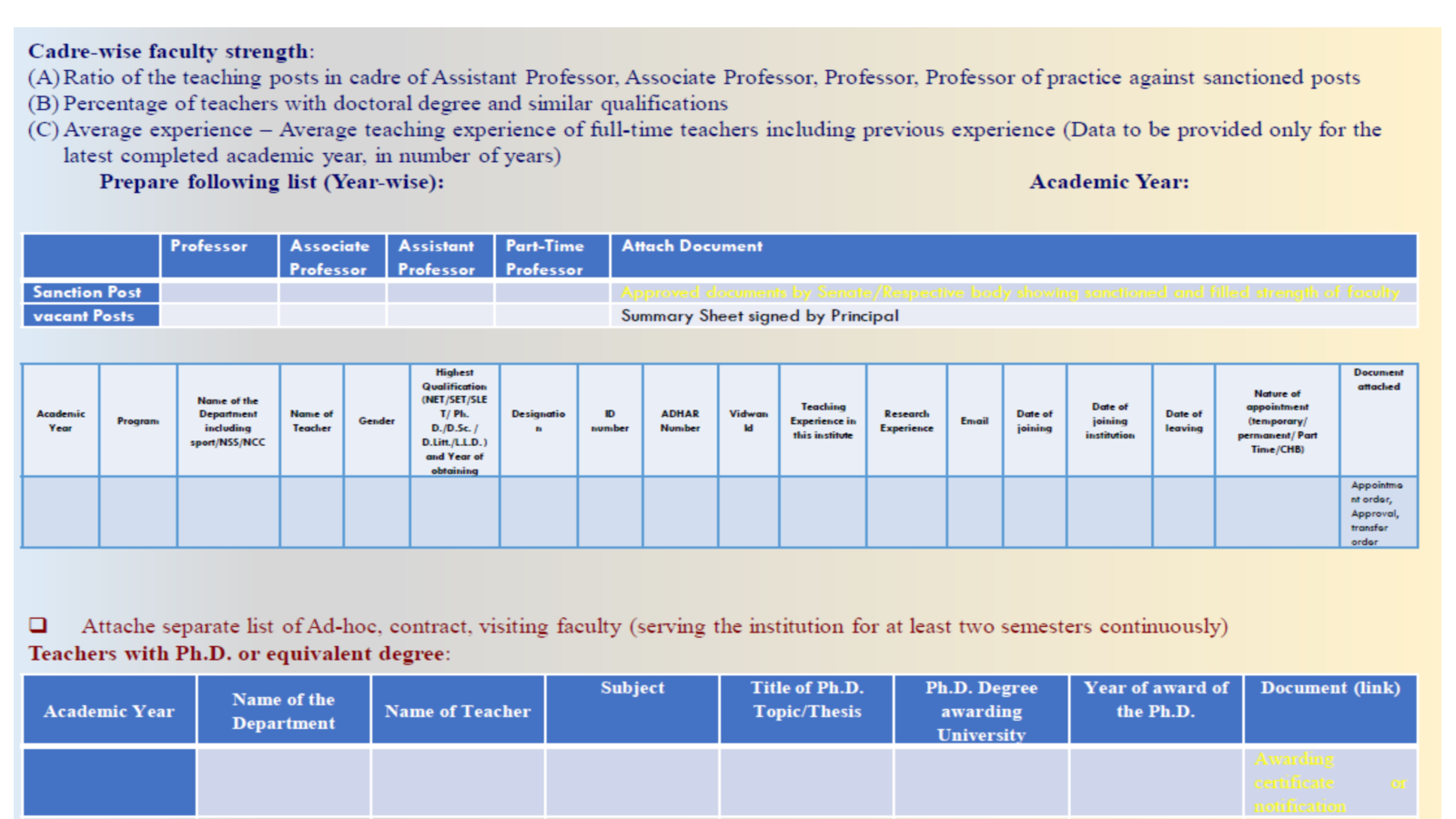
Number of students per faculty during the last three years, Cadre-wise faculty strength:

  • Total number of full-time teachers year-wise during the last three years.
  • Total number of students year-wise during the last three years

Faculty-Student Ratio | measurement, weightage and interpretation

How the metric is understood or measured

Student headcount ÷ eligible full-time teacher headcount

Draft weightage / source maximum

10 marks

Consultation metric 2.1

Not a verified final allocation or score-conversion rule.

Strategic planning & Discussion

Illustration only: 1,200 students ÷ 60 eligible full-time teachers = 20 students per teacher, or 1:20.

This example does not establish 1:20 as an official scoring threshold.

Metric 2. 7/ Supplementary • Faculty Quality and Qualifications

25 shared across quality subcomponentsSupplementary coverage · not an additional confirmed scored metric

Explain staff academic qualifications, cadre strength and teaching experience..

Documents to prepare and maintain

  • Cadre-wise sanctioned/filled post statement.
  • certified doctoral/equivalent qualification list and degree copies.
  • appointment/experience certificates.

Who is responsible?

  • HR/Establishment Office and HoDs.
  • individual faculty members.
  • Principal.

cadre-wise faculty strength

Template: cadre-wise faculty strength, faculty list and teachers with Ph.D. or equivalent degree

Faculty Quality and Qualifications | measurement, weightage and interpretation

How the metric is understood or measured

Doctoral-qualified eligible faculty ÷ eligible full-time faculty × 100. Average experience = total eligible teaching-experience years ÷ eligible teachers.

Draft weightage / source maximum

25 shared across quality subcomponents

Consultation metric 2.2

Not a verified final allocation or score-conversion rule.

Strategic planning & Discussion

Illustration only: 36 doctoral-qualified faculty ÷ 60 eligible full-time faculty × 100 = 60%.

The draft assigns 25 marks to a combined Faculty Quality group—not 25 marks to each subcomponent.

Weightage reference | read by topic, not source number

  • Recruitmentshared across quality subcomponents.
  • Pay and Allowancesshared across quality subcomponents.
  • Faculty Diversityshared across quality subcomponents
  • Faculty Development15 marks.
  • Faculty RetentionNot specified.
  • Faculty-Student Ratio10 marks.
  • Faculty Quality and Qualifications25 marks. shared across quality subcomponents.

Faculty preparation checklist

Prepare the evidence

  • Use approved, dated and signed academic/administrative records.
  • Prepare a concise explanation supported by the relevant primary records.
  • State the period, cohort, unit and counting method for numerical claims.
  • Use source-specified periods only where confirmed; verify the final applicable window.

Coordinate responsibility

  • Criteria coordinator consolidates the criterion; departments supply subject records.
  • HoDs verify academic claims; relevant offices verify finance, HR, exams and admissions.
  • Academic Council/Board of Studies approvals support curriculum decisions.
  • Protect personal data and use anonymised summaries for sensitive records.

Review and finalisation from IQAC side

Orientation discussion and immediate institutional actions

Questions for faculty and departments

  • Which existing activity demonstrates this criterion most convincingly?.
  • Which claim currently lacks an approved document or primary record?.
  • Where are counts inconsistent between departments and central offices?.
  • Which improvement needs an academic or administrative decision?.

Actions after the orientation

  • Nominate criterion Coordinator and metric-level faculty/office leads.
  • Prepare a document inventory and identify genuine gaps.
  • Correct the academic/administrative practice—not just the report wording.
  • Ask IQAC to confirm the applicable framework, periods and scoring source before submission.

2. Faculty Resources

Input

Input - Applications received (50/50/100)

Process
  • Constitution of Selection Committee, Shortlisting procedure, Personality aspects, Pedagogy, Integrated Scorewith appropriate weightage, etc.
  • Appropriate consideration of faculty selection parameters (e.g. Professional skills like performing arts, visualarts; writing case studies for management institute faculty) and practical based selection
  • Continuous professional development of teachers through the Malviya Mission Programme and othersimilar programmes approved by UGC/AICTE.
  • Consideration of parameters for ensuring social inclusivity measures in the HEIs (gender parity/disabled/ trans-person/ SDGs) with appropriate weightages
Outcome
  • Merit-based selection with due importance to equity and diversity
  • Reflection in career path of students