1. Curriculum Design

Faculty orientation deck · draft / consultation marks
75score (Autonomous)
8metrics (Autonomous)
Inputcategory

Criterion 1

Criterion 1 | Curriculum Design

Understanding the metrics · Preparing the institution

Meaning • Documents • Responsibilities • Measurement
8 baseline metrics + 0 supplementary topics

Orientation to the proposed ten-attribute reform framework. Consultation/draft marks are not final official scoring rules.

Faculty orientation edition • 23 October 2026

Metric 1.1 | Outcome-based Curriculum

15 marks

Begin with what graduates should know and be able to do. Programme outcomes (POs), programme-specific outcomes (PSOs) and course outcomes (COs) must guide curriculum and assessment.

Documents to prepare and maintain

  • Approved syllabi with POs, PSOs and COs.
  • Board of Studies and Academic Council minutes.
  • outcome mapping and attainment review.

Who is responsible?

  • Curriculum Committee and HoDs.
  • course teachers.
  • Board of Studies and Academic Council.
  • FYUGP Committee

Curriculum framework is in alignment with Program Specificoutcome or outcome based education (OBE) by defining:

  • POs,
  • COs
  • PEOs
  • PSOs.

Outcome-based Curriculum | measurement, weightage and interpretation

How the metric is understood or measured

Document-based review of approved outcomes, alignment and implementation—not merely a list of outcomes.

Draft weightage / source maximum

15 marks

Consultation metric 1.1

Not a verified final allocation or score-conversion rule.

Strategic planning & Discussion

A course outcome states that students will analyse a literary text using a specified critical approach. The assessment rubric tests that analytical ability.

What should graduates know and be able to do?

Do our teaching and assessments demonstrate achievement of these outcomes?

  1. Prepare measurable COs and document CO–PO/PSO alignment.
  2. Include outcome-linked activities in course plans.
  3. Map assessment questions and tasks to relevant COs.
  4. Review attainment results and record improvement actions

A generic CO copied into every course does not demonstrate outcome-based design.

Metric 1.2 | Stakeholder Participation

10 marks

Use student, teacher, alumni and employer inputs to improve the curriculum. Feedback becomes meaningful only when analysed, considered and followed by a recorded decision.

Documents to prepare and maintain

  • Stakeholder feedback instruments and responses on each Course and programme
  • analysis and action-taken report.
  • approval minutes showing accepted or rejected recommendations.
  • Demonstrate Online Feedback and analysis mechanism

Who is responsible?

  • Feedback Committee and HoDs.
  • alumni and employer representatives.
  • Board of Studies.

Participation of Students Teachers Employers/Industry , Alumni Entrepreneurs in curriculum design , –University/ Autonomous colleges analyse & incorporate in curriculum design received from –

  • Students
  • Teachers
  • Employers/Industry
  • Alumni

Stakeholder Participation | measurement, weightage and interpretation

How the metric is understood or measured

Show the chain: feedback → analysis → academic decision → implemented change → communication to stakeholders.

Draft weightage / source maximum

10 marks

Consultation metric 1.2

Not a verified final allocation or score-conversion rule.

Strategic planning & Discussion

What curriculum gaps have stakeholders identified?

Which suggestions should inform curriculum revision, and why?

  • Conduct curriculum-feedback surveys with students, teachers, employers/industry and alumni.
  • Organise curriculum-review meetings with stakeholder representatives.
  • Invite entrepreneurs to discuss emerging skills and professional needs.

A feedback form without analysis or an action-taken record is incomplete preparation.

Metric 1.3 | Curriculum Flexibility

10 marks

Explain the genuine choices available to learners: electives, major/minor options, credit transfer and other approved pathways. A policy must be distinguished from actual student access.

Documents to prepare and maintain

  • Academic regulations and programme structure.
  • elective/credit-transfer approval and student records.
  • academic-body minutes.

Who is responsible?

  • FYUGP Committee Board of Studies
  • HoDs.
  • Academic Council.

Academic Curriculum Flexibility is reflected through incorporation of component such as-

  • Choice Based Credit System (CBCS)
  • Multiple Entry and Multiple Exit (MEME)
  • Academic Bank of Credits (ABC )
  • Credit transfer from other institution/organisation
  • Dual or Integrated Degree programme
  • Major/Minor options
  • Use of Bharatiya Bhashas in learning and teaching
  • Open electives
  • Elective courses and compulsory courses engagements/inter-institution credit transfer

Data template

Sr. No.Course TypeCreditsCourse NameCourse Code: TheoryCourse Code: Practical
1Major 104*
Major 204*
Major 304*
2Major Elective (Same as major)--------
3Minor (Other than major)--------
4GE/OE (Generic/Open Elective)02
5VSC (Vocational Skill Course)--------
6SEC (Skill Enhancement Course)02
7AEC (Ability Enhancement Course)02AEC-1 English†
8VEC (Value Education Courses)--------
9IKS (Indian Knowledge System Course)02
10OJT (On-the-Job Training)--------
11FP (Field Project)--------
12CEP (Community Engagement Projects)--------
13CC (Co-curricular Courses)02CC-1: Health & Wellness†

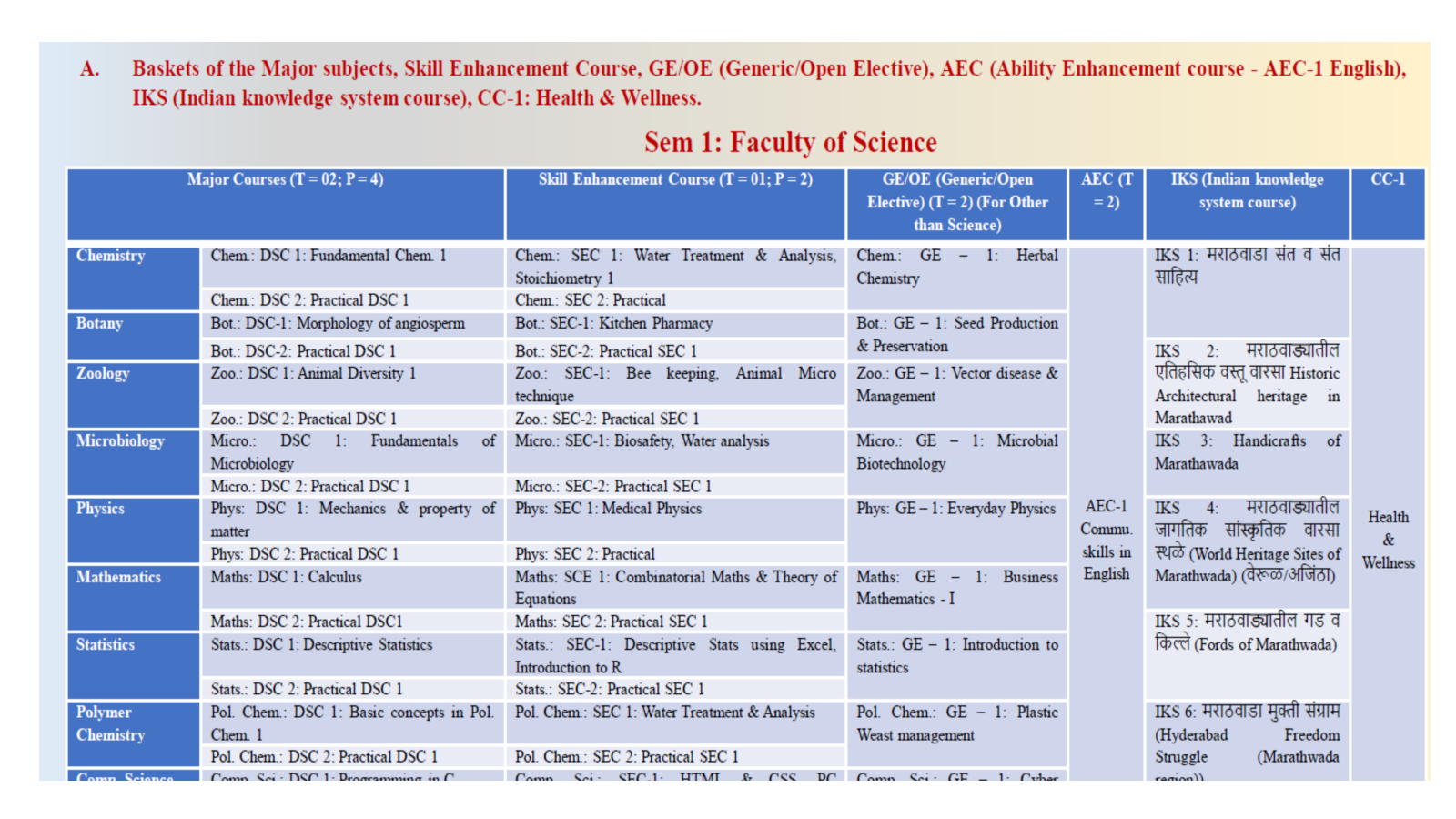
Sem 1 baskets, Faculty of Science (example)

Example: baskets of the major subjects, skill enhancement, GE/OE, AEC, IKS and CC-1 courses, Sem 1, Faculty of Science

Curriculum Flexibility | measurement, weightage and interpretation

How the metric is understood or measured

Document which options are approved and operational; report actual uptake separately from availability.

Draft weightage / source maximum

10 marks

Consultation metric 1.3

Not a verified final allocation or score-conversion rule.

Strategic planning & Discussion

What meaningful choices does our curriculum offer students?

What barriers prevent students from using available flexible pathways?

  • Explain approved course choices, prerequisites and credit requirements.
  • Guide students in selecting electives and major/minor pathways.
  • Support learning through Bharatiya Bhashas, where available.
  • Document student uptake of flexible curriculum options
  • Coordinate inter-institutional arrangements and student guidance

A brochure promise is weaker than a workable, approved choice.

Metric 1.4 | Practical and Industry Focus

10 marks

Embed fieldwork, projects, internships, apprenticeship and hands-on learning in approved curricula. A one-off industry visit is not automatically a curriculum component.

Documents to prepare and maintain

  • Approved course and programme contents.
  • internship/project schedules and host records.
  • assessment rubrics and evaluated reports.

Who is responsible?

  • HoDs and programme coordinators.
  • internship/placement cell.
  • Board of Studies.

Percentage of courses with emphasis on:

  • Skill based training
  • Embedded apprenticeship and or Field projects
  • Research projects
  • Internships - Ideas generated while working that fostered andencouraged as a business plan to initiate self-employment.
  • Field work
  • Practical hands-on training, etc.

Courses with Practical and Industry Focus

Table 1. Courses with Practical and Industry Focus

ProgrammeCourses Having Skill-Based TrainingSyllabus Link Highlighting Skill-Based TrainingCourses Having Embedded Apprenticeship and/or Field ProjectsSyllabus Link Highlighting Apprenticeship / Field ProjectsCourses Having FieldworkSyllabus Link Highlighting FieldworkDetails of Practical Hands-on Training and DateOther Training Activities and Date

Table 2. Activity Details and Supporting Documents

Academic YearName of Department / CommitteeType of Activity (Skill / Project / Internship / Field Project)Details / Name of ActivityDateNumber of Students Benefited / Names of StudentsDocument Link

Practical and Industry Focus | measurement, weightage and interpretation

How the metric is understood or measured

Eligible practical/industry-focused courses ÷ all eligible courses × 100. Also record programmes with credited internship/project ÷ total programmes × 100.

Draft weightage / source maximum

10 marks

Consultation metric 1.4

Not a verified final allocation or score-conversion rule.

Strategic planning & Discussion

Illustration only: 24 qualifying courses out of 80 courses gives 24 ÷ 80 × 100 = 30%.

Which courses provide practical experience relevant to employment or self-employment?

How can industry and community partners strengthen experiential learning?

  • Integrate skill-based tasks, fieldwork and hands-on training into courses.
  • Facilitate internships, apprenticeships, field projects and research projects.
  • Encourage students to develop workplace-generated ideas into business plans

30% is the indicator value—not automatically 30% of the metric marks.

Metric 1.5 | Practical and Skill Orientation

10 marks

Identify the skills a course develops and how students demonstrate them. Explain alignment with relevant qualifications or credit frameworks where applicable.

Documents to prepare and maintain

  • Skill-course syllabus and competency mapping.
  • approved framework-alignment document.
  • practical assessment rubrics and student work.

Who is responsible?

  • Skill-course coordinators and HoDs.
  • Board of Studies.
  • Academic Council.

Percentage of Skill oriented Courses aligned with NSQF and Skill focus included in curriculum design courses in last three years – (see 5 4 Metrics) .

  • NSQF only
  • NHEQF only
  • NSQF & NHEQF

Practical and Skill Orientation | measurement, weightage and interpretation

How the metric is understood or measured

Map course outcomes to identified skills and applicable framework levels; do not claim alignment without approval and evidence.

Draft weightage / source maximum

10 marks

Consultation metric 1.5

Not a verified final allocation or score-conversion rule.

Strategic planning & Discussion

What skills should students demonstrate after completing the course?

How do learning activities and assessments verify these skills?

  • Map each course to specific practical and professional skills.
  • Organise hands-on tasks, simulations and skill demonstrations.
  • Use projects and portfolios to showcase student competence

Do not claim NSQF/NHEQF alignment merely because a course is practical.

Metric 1.6 | Online and Blended Learning

5 marks

Integrate recognised online learning with approved credit recognition. Watching online content is not the same as completing a credit-bearing online course.

Documents to prepare and maintain

  • Online/blended-learning and credit policy.
  • approved course list.
  • completion certificates and credit-recognition records.

Who is responsible?

  • Academic Dean and LMS coordinator.
  • course teachers.
  • Controller of Examinations.

Percentage of online course through SWAYAM/SWAYAM Plus andother recognized platforms, which are credited in the curriculumduring the last three years –

Number of courses/

Total number ofcourses (without repeat count)

- (see 5.3 Metrics)

Online and Blended Learning | measurement, weightage and interpretation

How the metric is understood or measured

Online courses credited in the curriculum ÷ total eligible courses × 100; use the same course-counting scope.

Draft weightage / source maximum

5 marks

Consultation metric 1.7

Not a verified final allocation or score-conversion rule.

Strategic planning & Discussion

Illustration only: 6 credited online courses out of 120 eligible courses gives 5%.

Which online courses complement our curriculum?

How can we support students in completing courses and obtaining approved credits?

  • Establish LMS and start online support for all courses.
  • Plan Online/ Hybrid add on Courses and signature courses/ Open ended Modules online
  • Identify relevant courses on SWAYAM, SWAYAM Plus and other recognised platforms.
  • Orient students on approved online courses and curriculum credit provisions.
  • Provide mentoring and learning support for course completion

Completion certificates do not prove that credits were recognised in the curriculum.

Metric 1.7 | Curriculum Revision

10 marks

Demonstrate purposeful curriculum renewal based on developments in knowledge, skills, feedback and learner needs. Preserve the previous and revised versions.

Documents to prepare and maintain

  • List of programs where syllabus revision
  • has been carried out during the last three
  • Years as certified by registrar to be provided.
  • Approved minutes of the relevant BOS/Senate/ Academic Council document meetings

Who is responsible?

  • Board of Studies and HoDs.
  • Curriculum Committee
  • academic administration.

The frequency of curriculum revision (Program and courses) in the last three years.

  • Percentage/Total number of courses introduced or revised across all programs during the last three years –
  • Total number of courses (without repeat count) across all programmes during the last three years

Curriculum Revision | measurement, weightage and interpretation

How the metric is understood or measured

Courses introduced or revised ÷ total eligible courses × 100. Identify the source period and avoid repeat counting.

Draft weightage / source maximum

10 marks

Consultation metric 1.8

Not a verified final allocation or score-conversion rule.

Strategic planning & Discussion

Illustration only: 18 distinct courses revised out of 90 eligible courses gives 20%.

Which courses need revision, and what evidence supports the changes?

How have stakeholder feedback and disciplinary developments informed revisions

  1. Submit course-wise revision proposals with clear justification.
  2. Prepare old–new syllabus comparisons highlighting changes.
  3. Record approval dates, implementation dates and supporting minutes

Do not count one course repeatedly because several sections teach it.

Metric 1.8 | Indian Knowledge System (IKS)

5 marks

Integrate relevant Indian knowledge traditions through courses, curriculum components, projects and academic activities. Show educational content and learning, not only ceremonial events.

Documents to prepare and maintain

  • Approved IKS syllabus/components.
  • workshop or certificate-course schedules and reports.
  • evaluated projects or IKS centre notification.

Who is responsible?

  • IKS coordinator and subject departments.
  • Board of Studies.
  • Academic Council.

IKS is promoted through integration of components in curriculum such as – (see 5.5 Metrics)

  • Workshops/seminars on IKS
  • Certificate Courses on IKS
  • Components of IKS in core curriculum
  • Promotion of students projects, faculty and researches in IKS
  • Centre for IKS

Indian Knowledge System (IKS) | measurement, weightage and interpretation

How the metric is understood or measured

Document curriculum integration, academic activity and assessed learning

Draft weightage / source maximum

5 marks

Consultation metric 1.6

Not a verified final allocation or score-conversion rule.

Strategic planning & Discussion

Which IKS themes meaningfully connect with our disciplines?

How can students critically engage with relevant texts, practices and local knowledge?

  1. Organise IKS workshops, seminars and expert interactions.
  2. Develop certificate courses and integrate relevant IKS components into core courses.
  3. Encourage student projects and faculty research on IKS.
  4. Establish IKS Centre

An event title alone does not establish academic integration.

Weightage reference

  • Outcome-based Curriculum15 marks.
  • Stakeholder Participation10 marks.
  • Curriculum Flexibility10 marks.
  • Practical and Industry Focus10 marks.
  • Practical and Skill Orientation10 marks.
  • Online and Blended Learning5 marks.
  • Curriculum Revision10 marks.
  • Indian Knowledge System (IKS)5 marks.

Faculty preparation checklist

Prepare the evidence

  • Use approved, dated and signed academic/administrative records.
  • Prepare a concise explanation supported by the relevant primary records.
  • State the period, cohort, unit and counting method for numerical claims.

Coordinate responsibility

  • Criterion coordinator consolidates the criterion; departments supply subject records.
  • HoDs verify academic claims; relevant offices verify finance, HR, exams and admissions.
  • Academic Council/Board of Studies approvals support curriculum decisions.
  • Protect personal data and use anonymised summaries for sensitive records.

Review and finalisation from IQAC side

Orientation discussion and immediate institutional actions

Questions for faculty and departments

  • Which existing activity demonstrates this criterion most convincingly?.
  • Which claim currently lacks an approved document or primary record?.
  • Where are counts inconsistent between departments and central offices?.
  • Which improvement needs an academic or administrative decision?.

Actions after the orientation

  • Nominate criterion Coordinator and metric-level faculty team/office leads.
  • Prepare a document inventory and identify genuine gaps.
  • Correct the academic/administrative practice—not just the report wording.
  • Ask IQAC to confirm the applicable framework, periods and scoring source before submission.

1. Curriculum Design

Input

Inputs - Open for public viewing in their portals (75/75/50)

Process
  • Students’ Feedback
  • Teachers’ Feedback
  • Stakeholders’ involvement
  • Method of periodic upgradation
  • Review mechanism
  • Transparent responsible and inclusive methods of functioning
  • Expanding access to high-quality Technical and Vocational Education and Training (TVET)
  • Emphasizing the importance of enabling life-long learning focused on skilling, reskilling, and upskilling especially for vulnerable groups
  • Encourage mobility of students, scholars, across higher education institutions
Outcome
  • Successful completion of Course (Passing) – Result analysis, drop-out ratio
  • Updated knowledge
  • Time management catering to the needs of the semester system – Academic calendar, Examcalendar, programs and extension activity calendar, etc.
  • Policies - Innovative ideas/ways of exercising policies/ patents/high impact publications, books, etc.
  • Teaching content contextualised leading to real-world skilling in the learners
  • Enable personal accomplishment and enlightenment, constructive public engagement, and productivecontribution to the society
  • Multidisciplinary and holistic education

High progression to higher education, High placements or self-generated jobs (entrepreneur), innovations,Awards/Recognitions/ Inventions/Wealth generation, students with more meaningful and satisfying livesand work roles and economic independence