Decoding NAACBinary Accreditation
Strengthening Our Practice
St. Joseph College Devagiri
Opendoor Concepts & Connects Project
National Education Policy & Higher Education Reforms
“ensure inclusive and equitable quality education and promote lifelong learning opportunities for all”

Major problems of H.E. as per N.E.P.
- (a) a severely fragmented higher educational ecosystem;
- (b) less emphasis on the development of cognitive skills and learning outcomes;
- (c) a rigid separation of disciplines, with early specialisation and streaming of students into narrow areas of study;
- (d) limited access particularly in socio-economically disadvantaged areas, with few HEIs that teach in local languages
- (e) limited teacher and institutional autonomy;
- (f) inadequate mechanisms for merit-based career management and progression of faculty and institutional leaders;
- (g) lesser emphasis on research at most universities and colleges, and lack of competitive peer reviewed research funding across disciplines;
- (h) suboptimal governance and leadership of HEIs;
- (i) an ineffective regulatory system;
- (j) large affiliating universities resulting in low standards of undergraduate education.
Paradigm Shift in HE
- Student centred Education.
- The policy aims to increase the Gross Enrolment Ratio (GER) in higher education to 50% by 2035. Around 5 crore seats to be added.
- Multidisciplinarity and a holistic education - moving towards multidisciplinary universities and colleges. One large multidisciplinary HEI in every district. The system of ‘affiliated colleges’ will be gradually phased out over a period of fifteen years.
- Professionalisation & Internationalisation
- Focus to Vocational Education.
- Continuous review. ‘light but tight’ regulatory framework: A single body with verticals: Higher Education Commission of India (HECI).
- Promotion of Indian Language Culture and Tradition
- Outcome Based Education
- Online /Open Distance Learning
- Outstanding research ( From theoretical to Problem Solving)
Regulatory Bodies
HECI – A Single Regulatory Body with 4 Verticals
| Serial No | HECI Vertical | Function |
|---|---|---|
| 1 | National Higher Education Regulatory Council (NHERC) | Creating and Implementing Higher Education regulation |
| 2 | General Education Council (GEC) | Standard setting for academia |
| 3 | Higher Education Grants Council (HEGC) | For funding academic and research activities |
| 4 | National Accreditation Council (NAC) | Accreditation to academic institutions |
Other Bodies
- National Higher Education Qualification Framework (NHEQF)
- National Research Foundation
Four Types of HEI
( All are multidisciplinary)
“Through a suitable system of graded accreditation and graded autonomy, and in a phased manner over a period of 15 years, all HEIs in India will aim to become independent self-governing institutions pursuing innovation and excellence.”
Four Types of Courses in HEI
Traditional courses
no online technology is used in the course
Web-facilitated courses
1%–29% of the content presented using web technology during a face-to-face course.
Blended/Hybrid courses
30%–79% of the course involves engagement with web technology
Online courses
80% or more of the course content is delivered online
NAAC & AAA
NAAC and A & A
- National Assessment and Accreditation Council (NAAC) was established by the UGC in September 1994 at Bangalore for evaluating the performance of the Universities and Colleges in the Country.
- NAAC's mandate includes the task of performance evaluation, assessment and accreditation of universities and colleges in the country.
- The philosophy of NAAC is based on objective and continuous improvement rather than being punitive or judgmental, so that all institutions of higher learning are empowered to maximize their resources, opportunities and capabilities.
- Assessment is a performance evaluation of an institution and /or its units and is accomplished through a process based on self-study and peer review using defined criteria.
- Accreditation refers to the certification given by NAAC which is valid for a period of five years. At present the Assessment and Accreditation by NAAC is done on a voluntary basis.
Revised Assessment and Accreditation (A&A) Framework (Since July 2017)
The Shift is:
- from qualitative peer judgement to data based quantitative indicator evaluation with increased objectivity and transparency
- towards extensive use of ICT confirming scalability and robustness
- in terms of simplification of the process drastic reduction in number of questions, size of the report, visit days, and so on
- in terms of boosting benchmarking as quality improvement tool. This has been attempted through comparison of NAAC indicators with other international QA frameworks
Criterion wise Benchmark system adopted from CHEMS (Commonwealth Higher Education Management System 1996) methodology.
Revised Assessment and Accreditation (A&A) Framework (Since July 2017)
- introducing Pre-qualifier for peer team visit, as 25% of system generated score
- introducing System Generated Scores (SGS) with combination of online evaluation of Quantitative metrics and peer judgement of Qualitative metrics.
- in introducing the element of third party validation of data
- in providing appropriate differences in the metrics, weightages and benchmarks to universities, autonomous colleges and affiliated/constituent colleges
- in revising several metrics to bring in enhanced participation of students and alumni in the assessment process.
Process of Assessment (Old)
- IIQAInstitutional Information for Quality Assessment
- SSRSelf Study Report
- DVVData Validation & Verification
- SSSStudents Satisfaction Survey
- Peer Team Visit
- Result
Structure of SSR (Old)
- 1.Executive Summary
- 2.Profile of the Institution
- 2(a).Institutional preparedness for NEP
- 3.Extended Profile of the Institution
- 4.Quality Indicator Framework (QIF)
Quality Indicator Framework (QIF) Criterions (Old)
- Curricular Aspects
- Teaching-Learning and Evaluation
- Research, Innovations and Extension
- Infrastructure and Learning Resources
- Student Support and Progression
- Governance, Leadership and Management
- Institutional Values and Best Practices
BAF & MBGL 2025
The 'Why': Rationale for the New Framework
Alignment with NEP 2020
To create a transparent, technology-driven, and developmental accreditation system that is globally benchmarked.
Moving Beyond 'One-Size-Fits-All'
Recognizing the diverse nature, size, and developmental stages of over 45,000 Higher Education Institutions (HEIs) in India.
Enhancing Simplicity and Credibility
Shifting from a complex, input-heavy process to a more rational, outcome-focused evaluation.
Reducing Inspection-Centricity
Moving towards a continuous improvement model supported by technology, minimizing reliance on high-stakes peer team visits.
A Differentiated, Two-Stage Accreditation Process
Basic (Binary) Accreditation
What it is: A foundational, "Accredited" or "Not Accredited" assessment.
Goal: To ensure every institution meets fundamental quality standards. This is the first mandatory step for all HEIs.
Maturity-Based Graded Levels (MBGL)
What it is: A developmental, multi-level grading from Level 1 to 5.
Goal: For accredited institutions to assess their maturity and progress on the path to excellence. This stage is optional.
Basic (Binary) Accreditation: "Accredited / Not Accredited"
The Foundational Check
This stage acts as a basic "licence for quality," confirming that an institution has the necessary infrastructure, processes, and governance.
Simplified Metrics
The process will use a significantly smaller number of metrics focused on essential quality parameters.
Technology-Driven
Heavy reliance on authenticated data from the "One Nation One Data Platform" to ensure transparency and efficiency.
Outcome
A simple 'Yes/No' decision. An "Accredited" status is valid for a defined period, after which the institution can either apply for re-accreditation or opt for MBGL.
Maturity-Based Graded Levels (MBGL): The Path to Excellence
For Accredited Institutions: This is the next step for institutions wanting to be benchmarked on a scale of excellence.
A Developmental Scale: It evaluates the 'maturity' of an institution's quality culture, not just its current performance.
Focus on 'How': This framework assesses how deeply quality has been internalized across all functions of the institution.
The levels are
- Level 1 Institution on the path to 'National Excellence'
- Level 2 Institution achieving 'National Excellence'
- Level 3 Institution on the path to 'Global Excellence'
- Level 4 Institution achieving 'Global Excellence'
- Level 5 Institution recognized as a 'Global Leader of Excellence'
Paradigm Shift: Old System vs. New Framework
| Feature | Previous System (Pre-2025) | New Framework (2025 onwards) |
|---|---|---|
| Grading | Complex letter grades (A++, A+, B, etc.) | Binary (Yes/No) + Maturity Levels (1-5) |
| Approach | 'One-size-fits-all' for all HEIs | Differentiated two-stage process |
| Focus | Input and process-heavy | Outcome-centric and developmental |
| Data Source | Primarily self-reported by HEIs | Authenticated via "One Nation One Data" |
| Goal | Achieving a static grade | Fostering a continuous improvement journey |
Assessment Techniques
10 Criteria (Segmented: Input, Process, Outcomes)
AI-Powered Data Analytics
Digital Verification
Crowdsourced Feedback
AI-Enabled Verification and Mandatory Data Harmonization in DVV
Binary Accreditation - Highlights
Aligned with NEP 2020
Single Point Data Entry – Continues Updates – Validate from Stakeholders
No Peer Team Visit – Web based Assessment
Three Year Period Assessment & Two Stage Process (Optional)
Focus on Input, Process & Outcome & Impact
10 Attributes of Quality
Basic (Binary) Accreditation
Categories
Only “Accredited” or “Not Accredited”
Eligibility
Recognized by statutory authority, at least one batch of graduates
Assessment
Based on criteria and key indicators or 10 grouped attributes (input, process, outcome)
Process
Data submission and online validation; minimal/no physical visit
Validity
3 years
Focus
Minimum quality, inclusivity, cost-effectiveness, encourages participation from smaller/rural institutions
Limitations
No distinction among high-performing institutions; less granularity
Core Areas of Attributes
- Fundamental Recourse & Conditions
- Resources and Infrastructure available in the institution, including curriculum design, faculty qualification, facilities and financial resources.
- Active applications of Inputs in educational delivery system
- Teaching Methodologies, Faculty Students interactions, research initiatives etc..
- Effectively managed and implemented, student support services
- Outcomes, achievements in employment, startups, research etc..
- Assess the results and impact of the educational process, student learning outcomes, graduate employability, research outputs and contributions to society.
Input: 25 %, Process and Output: 75 %
The Input, The Process & The Outcome
- 1
Input
This category focuses on the resources and infrastructure available within an institution, including curriculum design, faculty qualifications, facilities, and financial resources. It assesses whether the institution has the necessary inputs to support effective teaching and learning processes.
- 2
Process
The process category evaluates the methods and procedures employed by an institution in delivering education. This includes curriculum engagement, teaching methodologies, student support services, and governance structures. It examines how effectively the institution translates its resources into meaningful educational experiences for students.
- 3
Outcome
The outcome category assesses the results and impact of the educational process. It looks at student learning outcomes, graduate employability, research output, and contributions to society. This category focuses on the tangible benefits and achievements resulting from the institution's educational endeavours.
Attributes, Metrics and Score Table
| Sr. No. | Attributes | Category | University | Autonomous | Affiliated | |||
|---|---|---|---|---|---|---|---|---|
| Metrics | Score | Metrics | Score | Metrics | Score | |||
| 1 | Curriculum Design | Input | 8 | 75 | 8 | 75 | 3 | 50 |
| 2 | Faculty Resources | Input | 6/3 | 50 | 6/3 | 50 | 5/3 | 100 |
| 3 | Infrastructure | Input | 6 | 50 | 5 | 50 | 5/3 | 75 |
| 4 | Financial Resources & Management | Input | 6/4 | 50 | 6/4 | 50 | 6/3 | 50 |
| 5 | Learning & Teaching | Process | 7 | 125 | 7 | 150 | 6/7 | 150 |
| 6 | Extended Curricular Engagements | Process | 6 | 100 | 6 | 125 | 6 | 125 |
| 7 | Governance and Administration | Process | 8/10 | 100 | 6/8 | 100 | 6/8 | 125 |
| 8 | Student Outcomes | Outcome | 8/4 | 150 | 8/4 | 125 | 8/5 | 100 |
| 9 | Research & Innovation Outcomes | Outcome | 8/7 | 125 | 6 | 100 | 4/2 | 50 |
| 10 | Sustainability Outcomes (Including Green Initiatives) | Outcome | 5/4 | 75 | 5/4 | 75 | 5/4 | 75 |
Category-wise Total Scores
| Category | University | Autonomous | Affiliated |
|---|---|---|---|
| Input | 225 | 225 | 275 |
| Process | 325 | 375 | 400 |
| Outcome | 350 | 300 | 225 |
| Core Attributes Subtotal | 900 | 900 | 900 |
| Uniqueness / Situatedness—Process / Outcome | 100 | 100 | 100 |
| Overall Total | 1,000 | 1,000 | 1,000 |
Total: 64 + 15 Metrics, 1000 Score
Input 25 Metrics · 225 Score
- Curriculum Design
- Faculty Resource
- Infrastructure
- Financial Recourses and Management
Process 19 Metrics · 375 Score
- Learning and Teaching
- Extended Curricular Engagements
- Governance and Administration
Output 17 Metrics · 300 Score
- Student Outcomes
- Research and Innovation Outcomes
- Sustainability Outcomes (Including Green Initiatives)
Process / Output 15 Metrics · 100 Score
- Uniqueness / Situatedness
- 15 Discipline Specific Metrics (100)
New / Modified Areas Specified in the Draft | attributes 1–5
| No. | Attribute | New / Modified Areas Specified in the draft |
|---|---|---|
| 1 | Curriculum Design |
|
| 2 | Faculty Resources |
|
| 3 | Infrastructure |
|
| 4 | Financial Resources & Management |
|
| 5 | Learning & Teaching |
|
New / Modified Areas Specified in the Draft | attributes 6–10
| No. | Attribute | New / Modified Areas Specified in the draft |
|---|---|---|
| 6 | Extended Curricular Engagements |
|
| 7 | Governance and Administration |
|
| 8 | Student Outcomes |
|
| 9 | Research & Innovation Outcomes |
|
| 10 | Sustainability Outcomes (Including Green Initiatives) |
|
Curriculum Design
8 baseline metrics + 0 supplementary topics
Metric 1.1Outcome-based Curriculum
Begin with what graduates should know and be able to do. Programme outcomes (POs), programme-specific outcomes (PSOs) and course outcomes (COs) must guide curriculum and assessment.
Documents to prepare and maintain
- Approved syllabi with POs, PSOs and COs.
- Board of Studies and Academic Council minutes.
- outcome mapping and attainment review.
Who is responsible?
- Curriculum Committee and HoDs.
- course teachers.
- Board of Studies and Academic Council.
- FYUGP Committee
Curriculum framework is in alignment with Program Specificoutcome or outcome based education (OBE) by defining:
- POs,
- COs
- PEOs
- PSOs.
Outcome-based Curriculum | measurement, weightage and interpretation
How the metric is understood or measured
Document-based review of approved outcomes, alignment and implementation—not merely a list of outcomes.
Draft weightage / source maximum
Consultation metric 1.1
Not a verified final allocation or score-conversion rule.
Strategic planning & Discussion
A course outcome states that students will analyse a literary text using a specified critical approach. The assessment rubric tests that analytical ability.
What should graduates know and be able to do?
Do our teaching and assessments demonstrate achievement of these outcomes?
- Prepare measurable COs and document CO–PO/PSO alignment.
- Include outcome-linked activities in course plans.
- Map assessment questions and tasks to relevant COs.
- Review attainment results and record improvement actions
A generic CO copied into every course does not demonstrate outcome-based design.
Metric 1.2Stakeholder Participation
Use student, teacher, alumni and employer inputs to improve the curriculum. Feedback becomes meaningful only when analysed, considered and followed by a recorded decision.
Documents to prepare and maintain
- Stakeholder feedback instruments and responses on each Course and programme
- analysis and action-taken report.
- approval minutes showing accepted or rejected recommendations.
- Demonstrate Online Feedback and analysis mechanism
Who is responsible?
- Feedback Committee and HoDs.
- alumni and employer representatives.
- Board of Studies.
Participation of Students Teachers Employers/Industry , Alumni Entrepreneurs in curriculum design , –University/ Autonomous colleges analyse & incorporate in curriculum design received from –
- Students
- Teachers
- Employers/Industry
- Alumni
Stakeholder Participation | measurement, weightage and interpretation
How the metric is understood or measured
Show the chain: feedback → analysis → academic decision → implemented change → communication to stakeholders.
Draft weightage / source maximum
Consultation metric 1.2
Not a verified final allocation or score-conversion rule.
Strategic planning & Discussion
What curriculum gaps have stakeholders identified?
Which suggestions should inform curriculum revision, and why?
- Conduct curriculum-feedback surveys with students, teachers, employers/industry and alumni.
- Organise curriculum-review meetings with stakeholder representatives.
- Invite entrepreneurs to discuss emerging skills and professional needs.
A feedback form without analysis or an action-taken record is incomplete preparation.
Metric 1.3Curriculum Flexibility
Explain the genuine choices available to learners: electives, major/minor options, credit transfer and other approved pathways. A policy must be distinguished from actual student access.
Documents to prepare and maintain
- Academic regulations and programme structure.
- elective/credit-transfer approval and student records.
- academic-body minutes.
Who is responsible?
- FYUGP Committee Board of Studies
- HoDs.
- Academic Council.
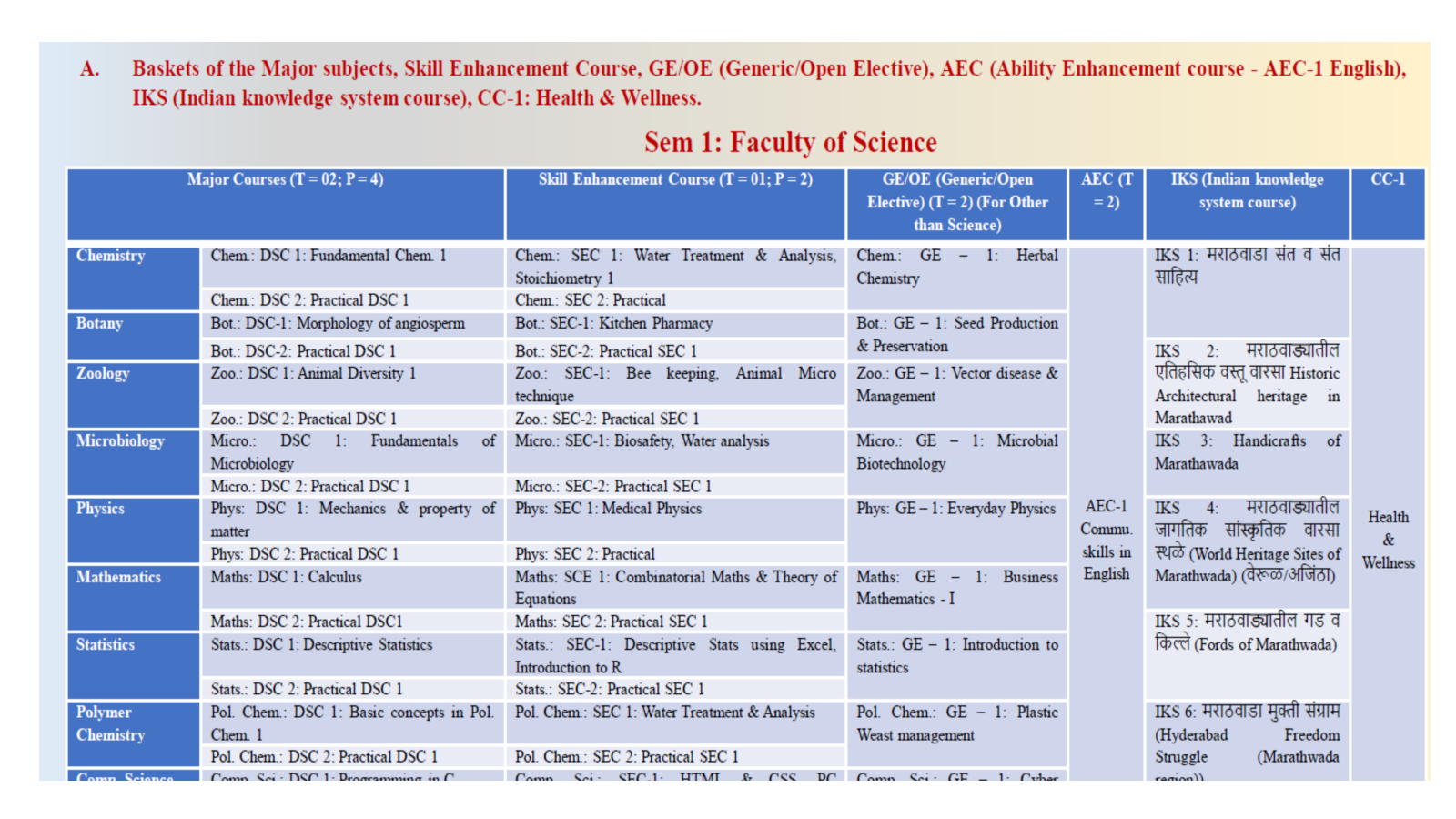
Academic Curriculum Flexibility is reflected through incorporation of component such as-
- Choice Based Credit System (CBCS)
- Multiple Entry and Multiple Exit (MEME)
- Academic Bank of Credits (ABC )
- Credit transfer from other institution/organisation
- Dual or Integrated Degree programme
- Major/Minor options
- Use of Bharatiya Bhashas in learning and teaching
- Open electives
- Elective courses and compulsory courses engagements/inter-institution credit transfer
| Sr. No. | Course Type | Credits | Course Name | Course Code: Theory | Course Code: Practical |
|---|---|---|---|---|---|
| 1 | Major 1 | 04* | |||
| Major 2 | 04* | ||||
| Major 3 | 04* | ||||
| 2 | Major Elective (Same as major) | -- | -- | -- | -- |
| 3 | Minor (Other than major) | -- | -- | -- | -- |
| 4 | GE/OE (Generic/Open Elective) | 02 | |||
| 5 | VSC (Vocational Skill Course) | -- | -- | -- | -- |
| 6 | SEC (Skill Enhancement Course) | 02 | |||
| 7 | AEC (Ability Enhancement Course) | 02 | AEC-1 English† | ||
| 8 | VEC (Value Education Courses) | -- | -- | -- | -- |
| 9 | IKS (Indian Knowledge System Course) | 02 | |||
| 10 | OJT (On-the-Job Training) | -- | -- | -- | -- |
| 11 | FP (Field Project) | -- | -- | -- | -- |
| 12 | CEP (Community Engagement Projects) | -- | -- | -- | -- |
| 13 | CC (Co-curricular Courses) | 02 | CC-1: Health & Wellness† |
Curriculum Flexibility | measurement, weightage and interpretation
How the metric is understood or measured
Document which options are approved and operational; report actual uptake separately from availability.
Draft weightage / source maximum
Consultation metric 1.3
Not a verified final allocation or score-conversion rule.
Strategic planning & Discussion
What meaningful choices does our curriculum offer students?
What barriers prevent students from using available flexible pathways?
- Explain approved course choices, prerequisites and credit requirements.
- Guide students in selecting electives and major/minor pathways.
- Support learning through Bharatiya Bhashas, where available.
- Document student uptake of flexible curriculum options
- Coordinate inter-institutional arrangements and student guidance
A brochure promise is weaker than a workable, approved choice.
Metric 1.4Practical and Industry Focus
Embed fieldwork, projects, internships, apprenticeship and hands-on learning in approved curricula. A one-off industry visit is not automatically a curriculum component.
Documents to prepare and maintain
- Approved course and programme contents.
- internship/project schedules and host records.
- assessment rubrics and evaluated reports.
Who is responsible?
- HoDs and programme coordinators.
- internship/placement cell.
- Board of Studies.
Percentage of courses with emphasis on:
- Skill based training
- Embedded apprenticeship and or Field projects
- Research projects
- Internships - Ideas generated while working that fostered andencouraged as a business plan to initiate self-employment.
- Field work
- Practical hands-on training, etc.
Table 1. Courses with Practical and Industry Focus
| Programme | Courses Having Skill-Based Training | Syllabus Link Highlighting Skill-Based Training | Courses Having Embedded Apprenticeship and/or Field Projects | Syllabus Link Highlighting Apprenticeship / Field Projects | Courses Having Fieldwork | Syllabus Link Highlighting Fieldwork | Details of Practical Hands-on Training and Date | Other Training Activities and Date |
|---|---|---|---|---|---|---|---|---|
Table 2. Activity Details and Supporting Documents
| Academic Year | Name of Department / Committee | Type of Activity (Skill / Project / Internship / Field Project) | Details / Name of Activity | Date | Number of Students Benefited / Names of Students | Document Link |
|---|---|---|---|---|---|---|
Practical and Industry Focus | measurement, weightage and interpretation
How the metric is understood or measured
Eligible practical/industry-focused courses ÷ all eligible courses × 100. Also record programmes with credited internship/project ÷ total programmes × 100.
Draft weightage / source maximum
Consultation metric 1.4
Not a verified final allocation or score-conversion rule.
Strategic planning & Discussion
Illustration only: 24 qualifying courses out of 80 courses gives 24 ÷ 80 × 100 = 30%.
Which courses provide practical experience relevant to employment or self-employment?
How can industry and community partners strengthen experiential learning?
- Integrate skill-based tasks, fieldwork and hands-on training into courses.
- Facilitate internships, apprenticeships, field projects and research projects.
- Encourage students to develop workplace-generated ideas into business plans
30% is the indicator value—not automatically 30% of the metric marks.
Metric 1.5Practical and Skill Orientation
Identify the skills a course develops and how students demonstrate them. Explain alignment with relevant qualifications or credit frameworks where applicable.
Documents to prepare and maintain
- Skill-course syllabus and competency mapping.
- approved framework-alignment document.
- practical assessment rubrics and student work.
Who is responsible?
- Skill-course coordinators and HoDs.
- Board of Studies.
- Academic Council.
Percentage of Skill oriented Courses aligned with NSQF and Skill focus included in curriculum design courses in last three years – (see 5 4 Metrics) .
- NSQF only
- NHEQF only
- NSQF & NHEQF
Practical and Skill Orientation | measurement, weightage and interpretation
How the metric is understood or measured
Map course outcomes to identified skills and applicable framework levels; do not claim alignment without approval and evidence.
Draft weightage / source maximum
Consultation metric 1.5
Not a verified final allocation or score-conversion rule.
Strategic planning & Discussion
What skills should students demonstrate after completing the course?
How do learning activities and assessments verify these skills?
- Map each course to specific practical and professional skills.
- Organise hands-on tasks, simulations and skill demonstrations.
- Use projects and portfolios to showcase student competence
Do not claim NSQF/NHEQF alignment merely because a course is practical.
Metric 1.6Online and Blended Learning
Integrate recognised online learning with approved credit recognition. Watching online content is not the same as completing a credit-bearing online course.
Documents to prepare and maintain
- Online/blended-learning and credit policy.
- approved course list.
- completion certificates and credit-recognition records.
Who is responsible?
- Academic Dean and LMS coordinator.
- course teachers.
- Controller of Examinations.
Percentage of online course through SWAYAM/SWAYAM Plus andother recognized platforms, which are credited in the curriculumduring the last three years –
Number of courses/
Total number ofcourses (without repeat count)
- (see 5.3 Metrics)
Online and Blended Learning | measurement, weightage and interpretation
How the metric is understood or measured
Online courses credited in the curriculum ÷ total eligible courses × 100; use the same course-counting scope.
Draft weightage / source maximum
Consultation metric 1.7
Not a verified final allocation or score-conversion rule.
Strategic planning & Discussion
Illustration only: 6 credited online courses out of 120 eligible courses gives 5%.
Which online courses complement our curriculum?
How can we support students in completing courses and obtaining approved credits?
- Establish LMS and start online support for all courses.
- Plan Online/ Hybrid add on Courses and signature courses/ Open ended Modules online
- Identify relevant courses on SWAYAM, SWAYAM Plus and other recognised platforms.
- Orient students on approved online courses and curriculum credit provisions.
- Provide mentoring and learning support for course completion
Completion certificates do not prove that credits were recognised in the curriculum.
Metric 1.7Curriculum Revision
Demonstrate purposeful curriculum renewal based on developments in knowledge, skills, feedback and learner needs. Preserve the previous and revised versions.
Documents to prepare and maintain
- List of programs where syllabus revision
- has been carried out during the last three
- Years as certified by registrar to be provided.
- Approved minutes of the relevant BOS/Senate/ Academic Council document meetings
Who is responsible?
- Board of Studies and HoDs.
- Curriculum Committee
- academic administration.
The frequency of curriculum revision (Program and courses) in the last three years.
- Percentage/Total number of courses introduced or revised across all programs during the last three years –
- Total number of courses (without repeat count) across all programmes during the last three years
Curriculum Revision | measurement, weightage and interpretation
How the metric is understood or measured
Courses introduced or revised ÷ total eligible courses × 100. Identify the source period and avoid repeat counting.
Draft weightage / source maximum
Consultation metric 1.8
Not a verified final allocation or score-conversion rule.
Strategic planning & Discussion
Illustration only: 18 distinct courses revised out of 90 eligible courses gives 20%.
Which courses need revision, and what evidence supports the changes?
How have stakeholder feedback and disciplinary developments informed revisions
- Submit course-wise revision proposals with clear justification.
- Prepare old–new syllabus comparisons highlighting changes.
- Record approval dates, implementation dates and supporting minutes
Do not count one course repeatedly because several sections teach it.
Metric 1.8Indian Knowledge System (IKS)
Integrate relevant Indian knowledge traditions through courses, curriculum components, projects and academic activities. Show educational content and learning, not only ceremonial events.
Documents to prepare and maintain
- Approved IKS syllabus/components.
- workshop or certificate-course schedules and reports.
- evaluated projects or IKS centre notification.
Who is responsible?
- IKS coordinator and subject departments.
- Board of Studies.
- Academic Council.
IKS is promoted through integration of components in curriculum such as – (see 5.5 Metrics)
- Workshops/seminars on IKS
- Certificate Courses on IKS
- Components of IKS in core curriculum
- Promotion of students projects, faculty and researches in IKS
- Centre for IKS
Indian Knowledge System (IKS) | measurement, weightage and interpretation
How the metric is understood or measured
Document curriculum integration, academic activity and assessed learning
Draft weightage / source maximum
Consultation metric 1.6
Not a verified final allocation or score-conversion rule.
Strategic planning & Discussion
Which IKS themes meaningfully connect with our disciplines?
How can students critically engage with relevant texts, practices and local knowledge?
- Organise IKS workshops, seminars and expert interactions.
- Develop certificate courses and integrate relevant IKS components into core courses.
- Encourage student projects and faculty research on IKS.
- Establish IKS Centre
An event title alone does not establish academic integration.
Weightage reference
- Outcome-based Curriculum15 marks.
- Stakeholder Participation10 marks.
- Curriculum Flexibility10 marks.
- Practical and Industry Focus10 marks.
- Practical and Skill Orientation10 marks.
- Online and Blended Learning5 marks.
- Curriculum Revision10 marks.
- Indian Knowledge System (IKS)5 marks.
Faculty preparation checklist
Prepare the evidence
- Use approved, dated and signed academic/administrative records.
- Prepare a concise explanation supported by the relevant primary records.
- State the period, cohort, unit and counting method for numerical claims.
Coordinate responsibility
- Criterion coordinator consolidates the criterion; departments supply subject records.
- HoDs verify academic claims; relevant offices verify finance, HR, exams and admissions.
- Academic Council/Board of Studies approvals support curriculum decisions.
- Protect personal data and use anonymised summaries for sensitive records.
Review and finalisation from IQAC side
Orientation discussion and immediate institutional actions
Questions for faculty and departments
- Which existing activity demonstrates this criterion most convincingly?.
- Which claim currently lacks an approved document or primary record?.
- Where are counts inconsistent between departments and central offices?.
- Which improvement needs an academic or administrative decision?.
Actions after the orientation
- Nominate criterion Coordinator and metric-level faculty team/office leads.
- Prepare a document inventory and identify genuine gaps.
- Correct the academic/administrative practice—not just the report wording.
- Ask IQAC to confirm the applicable framework, periods and scoring source before submission.
1. Curriculum Design
Inputs - Open for public viewing in their portals (75/75/50)
- Students’ Feedback
- Teachers’ Feedback
- Stakeholders’ involvement
- Method of periodic upgradation
- Review mechanism
- Transparent responsible and inclusive methods of functioning
- Expanding access to high-quality Technical and Vocational Education and Training (TVET)
- Emphasizing the importance of enabling life-long learning focused on skilling, reskilling, and upskilling especially for vulnerable groups
- Encourage mobility of students, scholars, across higher education institutions
- Successful completion of Course (Passing) – Result analysis, drop-out ratio
- Updated knowledge
- Time management catering to the needs of the semester system – Academic calendar, Examcalendar, programs and extension activity calendar, etc.
- Policies - Innovative ideas/ways of exercising policies/ patents/high impact publications, books, etc.
- Teaching content contextualised leading to real-world skilling in the learners
- Enable personal accomplishment and enlightenment, constructive public engagement, and productivecontribution to the society
- Multidisciplinary and holistic education
High progression to higher education, High placements or self-generated jobs (entrepreneur), innovations,Awards/Recognitions/ Inventions/Wealth generation, students with more meaningful and satisfying livesand work roles and economic independence
Faculty Resources
6 baseline metrics + 1 supplementary topics
Metric 2.1Recruitment
Demonstrate planned, transparent recruitment and adequate staffing against approved posts. Distinguish permanent, contract, visiting and other appointments.
Documents to prepare and maintain
- Sanctioned-post statement.
- recruitment and selection records.
- appointment and joining orders.
Who is responsible?
- Principal and management/appointing authority.
- HR/Establishment Office.
- HoDs.
Faculty sourcing practices includes:
- Short listing based on ORDINANCES of Central/ State/ other Universities
- List of candidates shortlisted posted on website of the institution
- Provision of appeal against short listing
- Selection committees constituted as per UGC regulation 2018
- Roster followed for selection of teachers
- Selection based on Academic Score/Written Test/Personal Interview
- Required No. of teaching position as per regulatory body and Filled UpPosts of Faculty
- Selection process for faculty transparent and open
Recruitment | measurement, weightage and interpretation
How the metric is understood or measured
Compare sanctioned and filled posts by cadre and discipline. Do not treat visiting appointments as permanent posts.
Draft weightage / source maximum
Strategic planning & Discussion
Orientation exercise: use real institutional details and show the primary record, the supporting evidence and the relevant approval or review.
Do not treat the number of documents, photographs or activities as an automatic assessment score.
Metric 2.2Pay and Allowances
Explain the institution's approved remuneration arrangements and whether payments are implemented consistently. Keep individual salary records confidential.
Documents to prepare and maintain
- Approved pay and allowance policy.
- appointment terms.
- certified payroll and payment reconciliation.
Who is responsible?
- Finance Officer and HR/Establishment Office.
- Principal.
- management.
Whether the pay and allowances are as per UGC/AICTE norms:
Pay and Allowances | measurement, weightage and interpretation
How the metric is understood or measured
Reconcile approved entitlements, payroll and actual payments; report aggregate evidence rather than personal bank details.
Draft weightage / source maximum
No autonomous metric-specific allocation available
Not a verified final allocation or score-conversion rule.
Strategic planning & Discussion
Orientation exercise: use one real institutional example and show the primary record, the supporting evidence and the relevant approval or review.
Do not treat the number of documents, photographs or activities as an automatic assessment score.
Metric 2.3Faculty Diversity
Describe the range of faculty backgrounds and expertise represented in the institution. Collect only necessary and authorised personal information.
Documents to prepare and maintain
- Verified faculty profiles.
- recruitment/diversity policy where adopted.
- aggregate faculty-composition statement.
Who is responsible?
- HR/Establishment Office and HoDs.
- Principal.
- relevant equality/inclusion committee.
Ratio of teachers with gender and geographic diversity to the total number of teachers
Faculty Diversity | measurement, weightage and interpretation
How the metric is understood or measured
Use a clearly stated population and reporting date,
Draft weightage / source maximum
No reliable autonomous metric-specific allocation available
Not a verified final allocation or score-conversion rule.
Strategic planning & Discussion
Orientation exercise: use real institutional data and show the primary record, the supporting evidence and the relevant approval or review.
Do not treat the number of documents, photographs or activities as an automatic assessment score.
Metric 2.4Faculty Development
Support teachers in updating subject knowledge, teaching methods, assessment and professional skills. Show how learning is applied after training.
Documents to prepare and maintain
- FDP/training calendar and sanction orders.
- attendance and completion certificates.
- Certified list of faculties attended training programs with details.-Certified/e-copies of the certificates of completion for faculty sponsored towards industrial training, fellowships, etc
Who is responsible?
- Faculty Development Committee and IQAC.
- HoDs.
- individual faculty members.
Percentage of faculty attended training programs (AICTE, UGC, ARPIT and similar), faculty sponsored for industrial training, fellowships etc.
- Number of full-time teachers attended orientation program/faculty development programmes and/or refresher courses
- Number of faculty members sponsored for industrial training (minimum two months), fellowships, etc. during last three years.
Faculty Development | measurement, weightage and interpretation
How the metric is understood or measured
Unique eligible teachers completing training ÷ eligible full-time teachers × 100 is an orientation indicator; official duration and eligibility rules require confirmation.
Draft weightage / source maximum
No reliable autonomous metric-specific allocation available
Not a verified final allocation or score-conversion rule.
Strategic planning & Discussion
Orientation exercise: use real institutional data and show the primary record, the supporting evidence and the relevant approval or review.
Do not treat the number of documents, photographs or activities as an automatic assessment score.
Metric 2.5Faculty Retention
Examine continuity of the teaching workforce and the reasons staff leave. Separate retention of an existing cohort from newly recruited staff.
Documents to prepare and maintain
- Certified faculty lists across the period.
- appointment and relieving orders.
- retained/left staff reconciliation.
Who is responsible?
- HR/Establishment Office.
- Principal.
- management.
- Total number of full-time teachers (without repeat count) worked in the institution during the last three years
Percentage of faculty worked in the institution continuously for the past three years against the sanctioned post:
Faculty Retention | measurement, weightage and interpretation
How the metric is understood or measured
Retained baseline faculty ÷ baseline faculty × 100. New hires do not replace leavers in the numerator.
Draft weightage / source maximum
Not a verified final allocation or score-conversion rule.
Strategic planning & Discussion
Illustration only: 42 of a baseline 50 teachers remain throughout the defined period: 84% retention.
Eight new recruits do not turn that cohort retention into 100%.
Metric 2.6Faculty-Student Ratio
Measure the number of students supported by each eligible full-time teacher. Both headcounts must cover the same institutional scope and period.
Documents to prepare and maintain
- Year-wise certified faculty roster.
- student rolls.
- signed ratio statement and reconciliation.
Who is responsible?
- HR and Admission/Academic Office.
- HoDs.
- Principal.
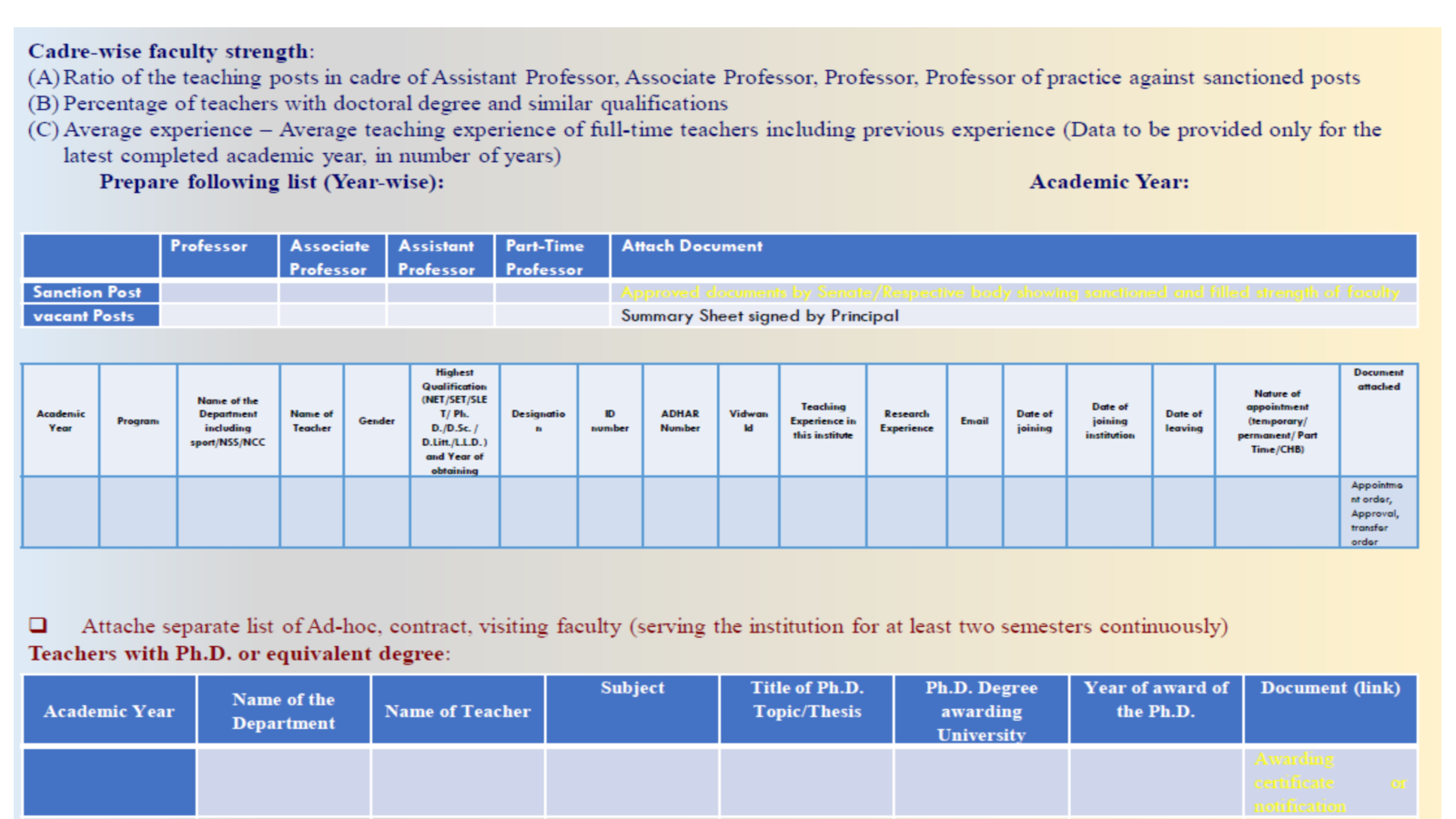
Number of students per faculty during the last three years, Cadre-wise faculty strength:
- Total number of full-time teachers year-wise during the last three years.
- Total number of students year-wise during the last three years
Faculty-Student Ratio | measurement, weightage and interpretation
How the metric is understood or measured
Student headcount ÷ eligible full-time teacher headcount
Draft weightage / source maximum
Consultation metric 2.1
Not a verified final allocation or score-conversion rule.
Strategic planning & Discussion
Illustration only: 1,200 students ÷ 60 eligible full-time teachers = 20 students per teacher, or 1:20.
This example does not establish 1:20 as an official scoring threshold.
Metric 2. 7/ Supplementary • Faculty Quality and Qualifications
Explain staff academic qualifications, cadre strength and teaching experience..
Documents to prepare and maintain
- Cadre-wise sanctioned/filled post statement.
- certified doctoral/equivalent qualification list and degree copies.
- appointment/experience certificates.
Who is responsible?
- HR/Establishment Office and HoDs.
- individual faculty members.
- Principal.
Faculty Quality and Qualifications | measurement, weightage and interpretation
How the metric is understood or measured
Doctoral-qualified eligible faculty ÷ eligible full-time faculty × 100. Average experience = total eligible teaching-experience years ÷ eligible teachers.
Draft weightage / source maximum
Consultation metric 2.2
Not a verified final allocation or score-conversion rule.
Strategic planning & Discussion
Illustration only: 36 doctoral-qualified faculty ÷ 60 eligible full-time faculty × 100 = 60%.
The draft assigns 25 marks to a combined Faculty Quality group—not 25 marks to each subcomponent.
Weightage reference | read by topic, not source number
- Recruitmentshared across quality subcomponents.
- Pay and Allowancesshared across quality subcomponents.
- Faculty Diversityshared across quality subcomponents
- Faculty Development15 marks.
- Faculty RetentionNot specified.
- Faculty-Student Ratio10 marks.
- Faculty Quality and Qualifications25 marks. shared across quality subcomponents.
Faculty preparation checklist
Prepare the evidence
- Use approved, dated and signed academic/administrative records.
- Prepare a concise explanation supported by the relevant primary records.
- State the period, cohort, unit and counting method for numerical claims.
- Use source-specified periods only where confirmed; verify the final applicable window.
Coordinate responsibility
- Criteria coordinator consolidates the criterion; departments supply subject records.
- HoDs verify academic claims; relevant offices verify finance, HR, exams and admissions.
- Academic Council/Board of Studies approvals support curriculum decisions.
- Protect personal data and use anonymised summaries for sensitive records.
Review and finalisation from IQAC side
Orientation discussion and immediate institutional actions
Questions for faculty and departments
- Which existing activity demonstrates this criterion most convincingly?.
- Which claim currently lacks an approved document or primary record?.
- Where are counts inconsistent between departments and central offices?.
- Which improvement needs an academic or administrative decision?.
Actions after the orientation
- Nominate criterion Coordinator and metric-level faculty/office leads.
- Prepare a document inventory and identify genuine gaps.
- Correct the academic/administrative practice—not just the report wording.
- Ask IQAC to confirm the applicable framework, periods and scoring source before submission.
2. Faculty Resources
Input - Applications received (50/50/100)
- Constitution of Selection Committee, Shortlisting procedure, Personality aspects, Pedagogy, Integrated Scorewith appropriate weightage, etc.
- Appropriate consideration of faculty selection parameters (e.g. Professional skills like performing arts, visualarts; writing case studies for management institute faculty) and practical based selection
- Continuous professional development of teachers through the Malviya Mission Programme and othersimilar programmes approved by UGC/AICTE.
- Consideration of parameters for ensuring social inclusivity measures in the HEIs (gender parity/disabled/ trans-person/ SDGs) with appropriate weightages
- Merit-based selection with due importance to equity and diversity
- Reflection in career path of students
Infrastructure
5 baseline metrics + 1 supplementary topics
Metric 3.1Physical Infrastructure
Show that teaching, student support and campus facilities are adequate, accessible and functional. Existence alone does not show availability for students.
Documents to prepare and maintain
- Applicable statutory norms and approved campus plan.
- facility/asset inventory.
- geotagged photographs and maintenance records.
The physical infrastructure facilities available in the institution includes (as per the requirements stipulated by the statutory authorities) include (with essential and auxillary):
- Classrooms/lecture halls
- Teaching Laboratories, Research Laboratory
- Workshops
- Hostel
- Computer Lab, Language Laboratory
- Sports facilities
- Grounds
- Gymnasium
- Auditoriums
- Seminar halls
- Health and wellness centre
- Canteen
- Guest House
- Transportation facilities
- Faculty common room
- Separate clean washrooms for girls and boys
- Clean drinking water facilities
- Adequate lighting facility
- Museum, Artifacts (classification in terms of academic/non-curriculum/Area)
Physical Infrastructure | measurement, weightage and interpretation
How the metric is understood or measured
Compare actual facilities and capacity with applicable norms; substantiate each selected facility.
Draft weightage / source maximum
Consultation metric 3.1
Not a verified final allocation or score-conversion rule.
Who is responsible?
- Building/Infrastructure Committee.
- administrative office.
- HoDs and management.
Strategic planning & Discussion
Orientation exercise: use real institutional data and show the primary record, the supporting evidence and the relevant approval or review.
Do not treat the number of documents, photographs or activities as an automatic assessment score.
Weightage sources W1/W2 are draft/consultation material. Percentage ≠ score; no invented thresholds.
| Physical Infrastructure Facilities | Name of Building | Floor | Total Area | Total Capacity | Facilities Available | Geo-Tagged Photo / Video | Attached Master Plan / Approved Plan |
|---|---|---|---|---|---|---|---|
| Classrooms / Lecture Halls | |||||||
| Teaching Laboratories | |||||||
| Research Laboratory | |||||||
| Workshops | |||||||
| Hostel | |||||||
| Computer Lab | |||||||
| Language Laboratory | |||||||
| Sports Facilities |
Metric 3.2Learning Resources
Demonstrate investment in books, e-books and digital learning resources, supported by audited expenditure. Availability and use strengthen the explanation.
Documents to prepare and maintain
- CA-certified audited statements with relevant expenditure highlighted.
- invoices/subscription records.
- library acquisition and usage reports.
Who is responsible?
- Librarian and Library Committee.
- Finance Officer.
- Principal.
Average expenditure on purchase of – Books, Language lab, e-books consortia membership, Subscription and digital resources, added to the library year wise during last three years
- Expenditure on purchase of books, e-books/subscription and digital resources year-wise during last three years (INR in Lakhs)
- Total expenditure excluding salary year-wise during the last three years
Table 1. Average Annual Expenditure
| Academic Year | Total Expenditure | Total Expenditure Excluding Salary, Year-wise | Expenditure on Purchase of Learning Resources |
|---|
Table 2. Expenditure on Books, E-books, Journals and Digital Resources
| Academic Year | Expenditure on Purchase of Books | Expenditure on Purchase / Annual Subscription of Periodicals, Journals, Magazines, Newspapers, etc. (Hard Copy) | Expenditure on Subscription / Purchase of E-books | Expenditure on Subscription / Purchase of Digital Resources, Including Digital Journals, Periodicals and Digital Newspapers |
|---|
Table 3. Expenditure, Funding and Supporting Documents
| Sr. No. | Academic Year | Particulars | Amount Spent | Source of Funding | Documents | Document Link / |
|---|---|---|---|---|---|---|
| 1 | Library and Purchase Committee meeting records | |||||
| 2 | Letter of sanction of funds or allocation of funds | |||||
| 3 | Bills for purchase or subscription of learning resources | |||||
| 4 | Audited Income and Expenditure Statement of the institution, signed by the Chartered Accountant (CA) and countersigned by the competent authority | |||||
| 5 | Self-attested photocopies of stock books—sample for each type |
Learning Resources | measurement, weightage and interpretation
How the metric is understood or measured
Eligible learning-resource expenditure ÷ total expenditure excluding salary × 100, using matching years and accounting units.
Draft weightage / source maximum
Consultation metric 3.2
Not a verified final allocation or score-conversion rule.
Strategic planning & Discussion
Illustration only: eligible library spending of 4 lakh ÷ non-salary expenditure of 80 lakh × 100 = 5%.
Use the same accounting period and do not include salary in an excluding-salary denominator.
Metric 3.3IT Infrastructure
Explain the digital infrastructure available for teaching and learning: connectivity, student-use computers, licensed software and technical support.
Documents to prepare and maintain
- Internet bills showing plan/bandwidth.
- computer stock register.
- IT committee minutes and facility photographs.(Geo tagged)
Who is responsible?
- IT Committee and system administrator.
- Purchase/Stock Office.
- Principal.
The IT infrastructure facilities include: High-speed and reliable internet, Effective Learning Management System, Virtual Labs/classroom, Technical support for ICT-related issues, Computers, Licenced software, AR/VR -Augmented Reality (AR) and Virtual Reality (VR) seamlessly integrate the digital world:
- Total available bandwidth of internet connection in the institution (in MBPS)
- Student computer ratio for the latest completed academic year – Numberof desktops/labtops available for student usages
| Academic Year | Facility | Documents: Purchase Bills / Annual or Monthly Bills / Charges (Scanned Copies) | Documents: Stock Book Entry (Attested Copy) | Geo-Tagged Photos / Videos |
|---|---|---|---|---|
| High-speed and reliable internet | ||||
| Effective Learning Management System | ||||
| Virtual labs / classroom—smart LCD screen facility | ||||
| Technical support for ICT-related issues | ||||
| Computers | ||||
| Licensed learning, data management and examination-related software | ||||
| Language laboratory facility | ||||
| Smart digital learning resources—KYAN / projectors | ||||
| Recording studio facility | ||||
| AR/VR—Augmented Reality and Virtual Reality facility | ||||
| Other facility | ||||
| Minutes and action-taken report of the IT Committee / any other relevant committee |
IT Infrastructure | measurement, weightage and interpretation
How the metric is understood or measured
Students ÷ computers available for student use. Report bandwidth separately; do not count administrative-only machines as student-use computers.
Draft weightage / source maximum
Consultation metric 3.4
Not a verified final allocation or score-conversion rule.
Strategic planning & Discussion
Illustration only: 1,200 students ÷ 100 student-use computers = 12 students per computer.
Bandwidth and student-computer ratio are different measures.
Metric 3.4Research Resources
Demonstrate access to resources enabling faculty and student research: databases, journals, software, laboratories and shared instrumentation.
Documents to prepare and maintain
- Subscription/membership and licence records.
- purchase decisions and committee minutes.
- facility access and utilisation records.
Who is responsible?
- Research Committee and Librarian.
- laboratory heads.
- Finance/Purchase Office.
The Institution has an e-Library (Research resources available atthe institution during last three years) –
- e – journals/consortia Membership/subscription,
- e – Shod Sindhu - Membership/subscription
- Discipline-specific Databases,
- Plagiarism Check software,
- Licensed statistical software,
- Discipline specific simulation software
- Central instrumentation centre/Facility
- Discipline specific research laboratory
- Any other to be specify
| Academic Year | Facility | Documents: Purchase Bills / Annual or Monthly Bills / Charges / Membership Letter or Relevant Documents (Scanned Copies) | Documents: Stock Book Entry (Attested Copy) | Screenshots / Geo-Tagged Photos / Videos |
|---|---|---|---|---|
| E-journals / consortia membership / subscription | ||||
| E-books (Reference) | ||||
| E-Shodh Sindhu membership / subscription | ||||
| Discipline-specific databases | ||||
| Plagiarism-check software | ||||
| Licensed statistical software | ||||
| Discipline-specific simulation software | ||||
| Any others | ||||
| Minutes of the Library Committee / any other relevant committees highlighting decisions on subscription / purchase | Link: |
Details of E-Resources
| Sr. No. | Academic Year | Particulars | Quantity / Publisher | Link to Access All Subscribed E-Resources |
|---|---|---|---|---|
Research Resources | measurement, weightage and interpretation
How the metric is understood or measured
Verify that claimed subscriptions and facilities were valid and available during the stated period.
Draft weightage / source maximum
Consultation metric 3.3
Not a verified final allocation or score-conversion rule.
Strategic planning & Discussion
Orientation exercise: use institutional data and show the primary record, the supporting evidence and the relevant approval or review.
Metric 3.5Divyangjan-friendly Facilities
Explain barrier-free access and support for learners with disabilities, including physical access, accessible information and assistive arrangements.
Documents to prepare and maintain
- Accessibility facility photographs.
- assistive-software procurement records.
- accessibility audit/action report and support arrangements.
Who is responsible?
- Accessibility/Equal Opportunity Committee.
- Estate and IT teams.
- student-support office.
The Divyangjan friendly, barrier free environment institution has facilities includes:
- Built environment with ramps/lifts for easy access to classrooms.
- Divyangan friendly washrooms
- Signage including tactile path, lights, display boards and signposts
- Assistive technology and facilities for Divyangjan - accessible website,screen-reading software, mechanized equipment.
- Provision for enquiry and information: Human assistance, reader,scribe, soft copies of reading material, screen reading
Divyangjan-friendly Facilities | measurement, weightage and interpretation
How the metric is understood or measured
Show usability and coverage, not only the presence of a ramp
Draft weightage / source maximum
Consultation metric 3.5
Not a verified final allocation or score-conversion rule.
Strategic planning & Discussion
Orientation exercise: use the real institutional situation and show the primary record, the supporting evidence and the relevant approval or review.
Metrics 3.6 /Supplementary • Innovation Resources
Describe facilities supporting ideation, prototyping and enterprise development.
Documents to prepare and maintain
- Innovation/tinkering facility records.
- incubator orders and equipment inventory.
- mentoring, utilisation and prototype reports.
Who is responsible?
- Innovation/Incubation Cell.
- research and entrepreneurship coordinators.
- management.
Availability of -Innovation/Tinkering Labs,Technology business incubatorsAny other incubation or innovation Facilities – Instruments, Software’s, Working facilities, IT laboratory, etc.
Innovation Resources | measurement, weightage and interpretation
How the metric is understood or measured
Supplementary topic: distinguish infrastructure from startup outcomes and avoid adding unsupported assessment marks.
Draft weightage / source maximum
No reliable autonomous metric-specific allocation available
Not a verified final allocation or score-conversion rule.
Strategic planning & Discussion
Orientation exercise: Discuss about the possibilities of developing this metric as an Institutional best practice
Do not treat the number of documents, photographs or activities as an automatic assessment score.
Weightage reference
- Physical Infrastructure10 marks.
- Learning Resources10 marks.
- IT Infrastructure10 marks.
- Research Resources15 marks.
- Divyangjan-friendly Facilities5 marks.
- Innovation ResourcesNot Applicable as per the draft.
3. Infrastructure
Inputs - Infrastructure Development (50/50/75)
- Details of land, classroom, research laboratory, computer centre, workshops, restaurant, theatre, dining hall, library, administrative office, faculty rooms, central stores, security, housekeeping, examination control office, placement office, common room, first aid cum sick room, guest house, sports club/ Gymnasium, auditorium, hostel
- Logistics for infrastructure for connecting to the students, faculty and staff
- Holistic view of the existing capabilities of the institution.
- Judgement of capabilities for expansion
Better outcomes from students and their academic courses; Creates an eco-system that ensures that a healthy development of courses, students ,faculty, and staff takes place
Faculty preparation checklist
Prepare the evidence
- Use approved, dated and signed academic/administrative records.
- Prepare a concise explanation supported by the relevant primary records.
- State the period, cohort, unit and counting method for numerical claims.
- Use source-specified periods only where confirmed; verify the final applicable window.
Coordinate responsibility
- Criteria coordinator consolidates the criterion; departments supply subject records.
- HoDs verify academic claims; relevant offices verify finance, HR, exams and admissions.
- Academic Council/Board of Studies approvals support curriculum decisions.
- Protect personal data and use anonymised summaries for sensitive records.
Orientation discussion and immediate institutional actions
Questions for faculty and departments
- Which existing activity demonstrates this criterion most convincingly?.
- Which claim currently lacks an approved document or primary record?.
- Where are counts inconsistent between departments and central offices?.
- Which improvement needs an academic or administrative decision?.
Actions after the orientation
- Nominate criterion and metric-level faculty/office leads.
- Prepare a document inventory and identify genuine gaps.
- Correct the academic/administrative practice—not just the report wording.
- Ask IQAC to confirm the applicable framework, periods and scoring source before submission.
Financial Resources and Management
6 baseline metrics + 0 supplementary topics
Metric 4.1Capital Income
Explain funds received for long-term institutional capacity, including infrastructure and equipment. Classify receipts consistently with the institution's audited accounts.
Documents to prepare and maintain
- CA-certified audited statements.
- Online MIS – Office software report, Cash book photocopy,
- grant/contribution/loan sanction documents.
- certified capital-receipt ledger extracts.
Who is responsible?
- Finance Officer/Accounts.
- management.
- authorised auditor.
The amount received towards Capital –
- Government grants
- Management contributions
- Loans
- Endowments, etc.
Capital Income | measurement, weightage and interpretation
How the metric is understood or measured
Capital income is paired with capital expenditure : capital income ÷ capital expenditure. Preserve both underlying amounts.
Draft weightage / source maximum
Consultation metric 4.1: capital income/expenditure ratio
Not a verified final allocation or score-conversion rule.
Strategic planning & Discussion
Illustration only: capital income 60 lakh ÷ capital expenditure 50 lakh = 1.2.
A ratio above 1 does not automatically mean full marks.
Metric 4.2Revenue Income
Explain recurring operational income such as fees, grants and other eligible receipts. Distinguish recognised income from cash movement.
Documents to prepare and maintain
- CA-certified income statement.
- fee/grant/other income registers.
- certified revenue-income ledger extracts.
Who is responsible?
- Finance Officer/Accounts.
- relevant grant and fee offices.
- authorised auditor.
Amount received from multiple sources like -
- Fees
- R&D grants
- Salary Grants
- Alumni contribution
- Consultancy
- Endowments
- Scholarships, etc.
Revenue Income | measurement, weightage and interpretation
How the metric is understood or measured
Revenue income is paired with revenue expenditure : revenue income ÷ revenue expenditure.
Draft weightage / source maximum
Consultation metric 4.2: revenue income/expenditure ratio
Not a verified final allocation or score-conversion rule.
Strategic planning & Discussion
Illustration only: revenue income 120 lakh ÷ revenue expenditure 100 lakh = 1.2.
A ratio is a financial indicator; official score conversion remains unverified.
Metric 4.3Capital Expenditure
Explain spending on long-term assets and infrastructure. Separate completed expenditure, outstanding commitments and capitalisation.
Documents to prepare and maintain
- CA-certified capital expenditure extracts.
- purchase/work orders and invoices.
- fixed-asset register.
Who is responsible?
- Finance Officer and Estate/Purchase Office.
- management.
- authorised auditor.
Capital Expenditure
Amount spent on various infrastructure like –
- Instructional building
- Academic infrastructure including library, hostels, residences,amenities, payment of rentals
Capital Expenditure | measurement, weightage and interpretation
How the metric is understood or measured
This is the expenditure component of the capital ratio. Do not assign it a second independent copy of the paired metric's marks.
Draft weightage / source maximum
Consultation metric 4.1: paired with Capital Income
Not a verified final allocation or score-conversion rule.
Strategic planning & Discussion
Orientation exercise: use real institutional example and show the primary record, the supporting evidence and the relevant approval or review.
| Academic Year | Capital: Instructional Building—New Construction | Capital: Academic Infrastructure (Library, Hostels, Residences, Amenities)—New Construction | Capital: Academic Infrastructure—On Rent | Revenue: Salaries | Revenue: Maintenance | Revenue: Administration | Revenue: Scholarships and Related Assistance | Revenue: Electricity | Revenue: Transport and TA | Revenue: Career Guidance and Skill Programmes | Revenue: Employee Benefits | Revenue: Extracurricular and Co-curricular Activities | Revenue: Other Expenditure |
|---|
Metric 4.4Revenue Expenditure
Explain recurring spending on salaries, maintenance, administration, student support and other operational heads. Use audited classifications.
Documents to prepare and maintain
- CA-certified expenditure statement.
- supporting ledgers/vouchers.
- approved budget and variance review.
Who is responsible?
- Finance Officer/Accounts.
- administrative and departmental budget holders.
- authorised auditor.
Revenue Expenditure
Amount spent on various heads like –
- Salaries
- Maintenance
- Administration
- Scholarships & assistance
- Electricity
- Transport
- Career Guidance and Skilling
- Employee benefits
- Extracurricular and co-curricular activities, etc
Revenue Expenditure | measurement, weightage and interpretation
How the metric is understood or measured
This is the expenditure component of the revenue ratio. Do not duplicate the paired metric's marks.
Draft weightage / source maximum
Consultation metric 4.2: paired with Revenue Income
Not a verified final allocation or score-conversion rule.
Strategic planning & Discussion
Orientation exercise: use real institutional example and show the primary record, the supporting evidence and the relevant approval or review.
Metric 4.5Sustainability and Growth
Explain the institution's ability to support its commitments over time through a corpus, prudent investment, diversified income and financial planning.
Documents to prepare and maintain
- Audited corpus/investment statements.
- approved finance policy and budget.
- financial plan and governing-body review.
Who is responsible?
- Management and Finance Committee.
- Finance Officer.
- Principal.
Strategies for financial sustainability and growth:
- Corpus created
- Diversification of Investments
- Plans for increasing capital and revenue income
- Decentralized budgeting
Sustainability and Growth | measurement, weightage and interpretation
How the metric is understood or measured
Discuss corpus and investment strategies supported by records. Forecasts are not realised income; no verified minimum corpus threshold is supplied.
Draft weightage / source maximum
Consultation metric 4.3
Not a verified final allocation or score-conversion rule.
Strategic planning & Discussion
Orientation exercise: use real institutional example and show the primary record, the supporting evidence and the relevant approval or review.
Metric 4.6Financial Controls and Risk Management
Show how authorisation, audit and risk review protect institutional resources and lead to corrective action.
Documents to prepare and maintain
- Internal and statutory audit reports.
- Audited income & expenditure statementcertified by CA
- finance/control policy.
- risk register and audit action-taken report.
Who is responsible?
- Finance Committee and Finance Officer.
- internal/external auditors.
- management.
Mechanisms of financial control are in place:
- Internal audits
- External/statutory audits
- Risk Management approaches
Financial Controls and Risk Management | measurement, weightage and interpretation
How the metric is understood or measured
Show the control, finding, action and closure. An audit certificate alone does not demonstrate resolution of audit observations.
Draft weightage / source maximum
Consultation metric 4.4
Not a verified final allocation or score-conversion rule.
Strategic planning & Discussion
Orientation exercise: use real institutional example and show the primary record, the supporting evidence and the relevant approval or review.
Weightage reference
- Capital Income20 shared with Revenue Income Capital Expenditure.
- Revenue Income20 shared with Capital Income.
- Capital ExpenditureNo separate allocation; 10 shares with Revenue Expenditure.
- Revenue ExpenditureNo separate allocation; 10 shares with Capital Expenditure.
- Sustainability and Growth10 marks.
- Financial Controls and Risk Management10 marks.
4. Financial Resources & Management
Inputs - Financial Resources & Management (50/50/50)
- Seed money for teachers, students and researchers
- Support for conferences, workshops, Seminars, equipment, research etc. to students, teachers and researchers
- Total Amount spent on developing facilities, library, e-resources, labs, training teachers and staff for undertaking outreach activities
- Amount spent on salary of teaching and non-teaching staff
- Expenditure on infrastructure augmentation
- Amount received in donation and CSR funds
- Revenue generated from outreach activities
- Utilized amount on library, labs, workshops, other expenditure, salary of teaching and non-teaching staff, maintenance of infrastructure, consumables, Seminars/Workshops/ Conferences, each value given separately for each of the last 3 financial years
- Detailed overview of the financial health and existing capabilities of the institution, Judgement
for expansion of the institutes
Faculty preparation checklist
Prepare the evidence
- Use approved, dated and signed academic/administrative records.
- Prepare a concise explanation supported by the relevant primary records.
- State the period, cohort, unit and counting method for numerical claims.
- Use source-specified periods only where confirmed; verify the final applicable window.
Coordinate responsibility
- Criteria coordinator consolidates the criterion; departments supply subject records.
- HoDs verify academic claims; relevant offices verify finance, HR, exams and admissions.
- Academic Council/Board of Studies approvals support curriculum decisions.
- Protect personal data and use anonymised summaries for sensitive records.
- Review and finalisation by IQAC
Orientation discussion and immediate institutional actions
Questions for faculty and departments
- Which existing activity demonstrates this criterion most convincingly?.
- Which claim currently lacks an approved document or primary record?.
- Where are counts inconsistent between departments and central offices?.
- Which improvement needs an academic or administrative decision?.
Actions after the orientation
- Nominate criterion coordinator and metric-level faculty/office leads.
- Prepare a document inventory and identify genuine gaps.
- Correct the academic/administrative practice—not just the report wording.
- Ask IQAC to confirm the applicable framework, periods and scoring source before submission.
Learning and Teaching
8 baseline metrics + 1 supplementary topics
Metric 5.1Pedagogical Approaches
Explain how teachers select methods that help students learn: peer, group, inquiry, problem-based, project-based and technology-supported learning.
Documents to prepare and maintain
- Sample lesson plans for each method claimed.
- teaching/activity records.
- assessed student work and reflection.• Data on website - links
Who is responsible?
- Individual teachers and course coordinators.
- HoDs.
- LMS Team /IQAC committee.
Teaching learning techniques include:
- Lecture based teaching-learning
- Group- teaching and learning
- Individual learning/self-study
- Inquiry based learning
- Kinaesthetic learning
- Game Based learning
- Expeditionary learning
- Technology based learning
- Peer teaching
- Learning through problem-solving,
- Project based learning, etc
Pedagogical Approaches | measurement, weightage and interpretation
How the metric is understood or measured
Document actual classroom use and learning purpose; a list of fashionable methods is not evidence of implementation.
Draft weightage / source maximum
Consultation metric 5.1
Not a verified final allocation or score-conversion rule.
Strategic planning & Discussion
Which topics need approaches beyond lectures?
How can we engage students with different learning needs?
What evidence will show that the chosen method improved learning?
- Redesign one lesson using an appropriate participatory approach.
- Specify the learning outcome, activity and assessment method.
- Maintain lesson plans, student outputs and brief reflections on effectiveness
Metric 5.2Internships and Field Projects
Explain supervised learning in workplaces or field settings, with defined objectives, completion and assessment. Separate curriculum-integrated work from optional exposure.
Documents to prepare and maintain
- Host permission and student allocation.
- attendance/completion certificates.
- evaluated reports and supervisor feedback.
Who is responsible?
- Internship/Fieldwork coordinator.
- HoDs and faculty supervisors.
- host organisations.
Percentage of students undertaking –
- Internships
- Field Projects
S1/S2: topic and numbering. W1/W2: contextual description where matched. Checklist/roles: advisory. · Image/source number: 5.2 • Included in the 63-metric autonomous working baseline
Internships and Field Projects | measurement, weightage and interpretation
How the metric is understood or measured
Unique participating students ÷ eligible students × 100 may describe coverage; the consultation source also captures curricular integration under Curriculum Design.
Draft weightage / source maximum
Strategic planning & Discussion
A field project has a defined question, supervisor, attendance, report and assessment.
How do internships and field projects connect classroom learning with real-world work?
What barriers prevent students from participating?
How will we assess individual learning and contribution?
- densify relevant internship opportunities and field-project partners.
- Define learning objectives, duration, supervision and assessment.
- Monitor participation, progress and completion.
Curricular integration overlaps consultation metric 1.4; do not duplicate its 10 Not a verified final allocation or score-conversion rule.
Do not count an informal trip as a completed assessed field project.
Metric 5.3Assessment
Explain continuous and end-course assessment and how methods test intended learning outcomes. Include fairness, moderation and timely feedback.
Documents to prepare and maintain
- Approved assessment regulations and BOE/Academic Council minutes.
- sample questions and rubrics.
- evaluated work and moderation records.
Who is responsible?
- Controller of Examinations and Examination Committee
- course teachers.
- HoDs.
The Continuous Evaluation system of the institution involves the following methods:
- Quiz with MCQ
- Seminar presentations
- Case study
- Projects
- Assignments
- Any other, please specify (for e.g. self-assessment, peer assessment, assessment of vocational skills)
Assessment | measurement, weightage and interpretation
How the metric is understood or measured
Show the approved components and actual assessment evidence. Internal assessment weights are not NAAC metric weightages.
Draft weightage / source maximum
Consultation metric 5.4
Not a verified final allocation or score-conversion rule.
Strategic planning & Discussion
Do our assessments test understanding and application—not just recall?
How can we ensure fair assessment of individual contributions?
How do students use feedback to improve their learning?
- Plan continuous assessment using suitable quizzes, seminars, case studies, projects and assignments.
- Align assessment tasks with course outcomes.
- Include self-assessment, peer assessment or vocational-skill assessment where appropriate.
- Provide timely feedback and opportunities for improvement
The course assessment scheme is not the NAAC scoring scheme.
Metric 5.4Academic Grievances Redressal
Explain student access to answer-script copies, re-totaling, re-evaluation and academic appeals under approved rules.
Documents to prepare and maintain
- Examination/grievance policy.
- anonymized case and disposal register.
- decision/appeal and closure records.Committee Minutes
Who is responsible?
- Controller of Examinations.
- Academic Grievance redressal Cell.
- Principal.
The Grievance redressal system in the academic areas includes:
- Sharing copies of answer script
- Re-totalling
- Re-evaluation
- Shortage Attendance
- Any others
Academic Grievances Redressal | measurement, weightage and interpretation
How the metric is understood or measured
Track receipt, decision and disposal time; restrict personal records. Do not invent a compulsory resolution-day threshold.
Draft weightage / source maximum
Consultation metric 5.6
Not a verified final allocation or score-conversion rule.
Strategic planning & Discussion
Do students know where and how to raise academic grievances?
How can we ensure fair, timely and confidential handling?
What recurring grievances indicate a need for systemic improvement?
- A re-evaluation request is acknowledged, decided under the published policy and closed with a recorded response.
- Communicate procedures for answer-script access, re-totalling and re-evaluation.
- Explain attendance-shortage rules and available grievance procedures.
- Provide accessible submission channels and clear resolution timelines.
Use anonymised summaries, not identifiable student case files, in public presentations.
Metric 5.5Catering to Diversity
Explain academic support for different preparation levels and learning needs through bridge, remedial, enrichment and language-support activities.
Documents to prepare and maintain
- Identification/support plan.
- circulars, timetables and participant lists.
- activity reports and progress review.
Who is responsible?
- HoDs and course teachers.
- remedial/bridge-course coordinators.
- student-support committees.
Support for Differential Learning includes:
- Inclusive Remedial Teaching;
- Peer assisted Remedial Teaching;
- Multi-Sensory Remedial Teaching;
- Bridge courses;
- Enrichment courses;
- Language proficiency courses;
- Teaching and writing examinations in Bhartiya Bhashas
Catering to Diversity | measurement, weightage and interpretation
How the metric is understood or measured
Identify the need, intervention and observed progress; do not label students publicly or equate attendance alone with improvement.
Draft weightage / source maximum
Consultation metric 5.5
Not a verified final allocation or score-conversion rule.
Strategic planning & Discussion
How do we identify learning needs without labelling or stigmatising students?
Which students need foundational support, language assistance or enrichment?
How will we assess whether the support has helped?
- Identify varied learning needs through entry-level assessments and student interaction.
- Plan inclusive, peer-assisted and multisensory remedial teaching.
- Offer bridge, enrichment and language-proficiency courses.
- Facilitate teaching and examination writing in Bharatiya Bhashas, according to applicable provisions
Metric 5.6Learning Management System
Explain the educational use of the institutional LMS for materials, activities, assignments, feedback and blended learning—not software development.
Documents to prepare and maintain
- Dated course/module screenshots.
- examples of assignments and feedback.
- activity summaries and learner-support records.
Who is responsible?
- Course teachers and LMS academic coordinator.
- HoDs.
- teaching-learning committee.
The Institutional LMS includes the following - Sharing teachingMaterial, Submission of Assignments,Mobile Learning, E-discussion platforms, Assessment outcomes, Blended learning support, Asynchronous learning:
Effective use of the institution LMS is reflected through the following:
- Sharing teaching materials
- Submission of assignment
- Assessment outcomes
- Blended learning support
Learning Management System | measurement, weightage and interpretation
How the metric is understood or measured
Demonstrate actual teaching use. Course-shell creation and login counts alone do not establish learning effectiveness.
Draft weightage / source maximum
Strategic planning & Discussion
Are we using the LMS for learning interaction—or only uploading files?
How can online activities complement classroom teaching?
What access or usability barriers do students face?
- Organise course-wise teaching materials and learning activities on the LMS.
- Enable assignment submission, feedback and assessment-result sharing.
- Integrate online activities with classroom teaching.
- Provide mobile-accessible resources, discussion forums and asynchronous learning opportunities.
Supporting draft metric 5.2 Not a verified final allocation or score-conversion rule.
Screenshots of empty courses do not show educational use.
Metric 5.7Industry-Academia Linkage
Explain active collaboration through expert teaching, visits, joint workshops and other relevant learning opportunities. Partnerships must generate activities.
Documents to prepare and maintain
- Valid agreement or collaboration letter.
- expert lecture/visit/workshop reports.
- attendance, feedback and outcomes.
Who is responsible?
- Industry-linkage and placement cells.
- HoDs.
- partner organisations.
Nature of industry academia collaboration and activities involvesthe following:
- Lectures from Industry experts
- Field visit/Industry visit
- Internship outside the curriculum
- Collaborative workshop/ seminar/ conference with industry and stakeholders
Industry-Academia Linkage | measurement, weightage and interpretation
How the metric is understood or measured
Distinguish signed agreements from activities implemented; connect the activity to student learning.
Draft weightage / source maximum
Strategic planning & Discussion
Which industry partnerships are relevant to our disciplines?
How can collaborations address students’ skill and career needs?
What learning or follow-up action should result from each activity?
- Organise lectures and interactions with industry experts.
- Arrange field visits and industry visits with defined learning objectives.
- Facilitate internships outside the curriculum.
- Conduct collaborative workshops, seminars and conferences with industry and stakeholders.
Supporting draft metric 5.3 Not a verified final allocation or score-conversion rule.
Metric 5.8 • Adherence to Academic Calendar
Explain delivery against the approved teaching and examination calendar and timely publication of results. Record actual dates and approved deviations.
Documents to prepare and maintain
- Approved academic calendar.
- teaching-day and examination records.
- COE reports and result notifications.
Who is responsible?
- Academic Coordinator and Controller of Examinations.
- HoDs.
- Principal.
- Whether the number of teaching days are followed as per the UGC guidelines:Number of teaching days in a year =
- Average number of days from the date of last semester end/year-end examination till the last date of declaration of result year-wise during the last three years
Adherence to Academic Calendar | measurement, weightage and interpretation
How the metric is understood or measured
Report teaching days and date difference between examination completion and result publication by semester/year. State the method before averaging.
Draft weightage / source maximum
Consultation metric 5.8
Not a verified final allocation or score-conversion rule.
Strategic planning & Discussion
If the final examination ends on 10 April and results are declared on 30 April, the elapsed interval is 20 days.
The date difference is an indicator, not a verified 20-day scoring rule.
Weightage reference
- Pedagogical Approaches35 marks.
- Internships and Field ProjectsNo separate allocation established.
- Assessment25 marks.
- Academic Grievances Redressal15 marks.
- Catering to Diversity15 marks.
- Learning Management System20 marks.
- Industry-Academia Linkage25 marks.
- Adherence to Academic Calendar15 marks.
Faculty preparation checklist
Prepare the evidence
- Use approved, dated and signed academic/administrative records.
- Prepare a concise explanation supported by the relevant primary records.
- State the period, cohort, unit and counting method for numerical claims.
- Use source-specified periods only where confirmed; verify the final applicable window.
Coordinate responsibility
- Lead coordinator consolidates the criterion; departments supply subject records.
- HoDs verify academic claims; relevant offices verify finance, HR, exams and admissions.
- Academic Council/Board of Studies approvals support curriculum decisions.
- Protect personal data and use anonymised summaries for sensitive records.
Orientation discussion and immediate institutional actions
Questions for faculty and departments
- Which existing activity demonstrates this criterion most convincingly?.
- Which claim currently lacks an approved document or primary record?.
- Where are counts inconsistent between departments and central offices?.
- Which improvement needs an academic or administrative decision?.
Actions after the orientation
- Nominate criterion and metric-level faculty/office leads.
- Prepare a document inventory and identify genuine gaps.
- Correct the academic/administrative practice—not just the report wording.
- Ask IQAC to confirm the applicable framework, periods and scoring source before submission.
Extended Curricular Engagements
6 baseline metrics + 1 supplementary topics
Metric 6.1Technical / Domain-related Clubs and Festivals
Explain how discipline-related clubs extend learning beyond the classroom through regular student participation and expert/professional engagement.
Documents to prepare and maintain
- Club details in prospectus.
- constitution/calendar.
- event reports, photographs and certified participant lists. • Geo tagged Photos
- Resume of resource person.
- Feed back analysis report.
- certificate sample copies,
Who is responsible?
- Club faculty coordinators and student office-bearers.
- HoDs.
- Student Affairs. Staff advisor
- No. of Technical/Domain Clubs with no. of students
- Total number of Activities club-wise
- No. of institutions participated in the Domain related festivals
- Involvement of industry bodies involved
- Number of professional bodies involved
- Number of Hackathons/workshops conducted
Technical / Domain-related Clubs and Festivals | measurement, weightage and interpretation
How the metric is understood or measured
Record clubs, activities, participating institutions and professional/industry bodies; keep event counts distinct from unique participants.
Draft weightage / source maximum
Consultation metric 6.1
Not a verified final allocation or score-conversion rule.
Strategic planning & Discussion
How do club activities extend disciplinary learning beyond the classroom?
How can we sustain participation beyond one annual festival?
What skills or outputs will demonstrate students’ learning?
- Establish discipline-related clubs with student leadership and faculty mentoring.
- Plan regular workshops, demonstrations, competitions and subject festivals.
- Involve experts, alumni and professional bodies in club activities.
- Encourage student-led projects connecting classroom concepts with practical applications.
Metric 6.2/ 6.1(Merged)Hackathons and Ideation Workshops
Explain structured problem-solving and idea development that produces proposals, prototypes or tested solutions. Not every workshop is a hackathon.
Documents to prepare and maintain
- Problem statement and programme.
- team registration/mentoring records.
- jury rubrics, outputs and follow-up reports.
Who is responsible?
- Innovation/Technical Club coordinators.
- faculty mentors.
- external experts.
Hackathons and Ideation Workshops | measurement, weightage and interpretation
How the metric is understood or measured
Record events, teams, outputs and follow-up; avoid double counting the same event under domain-club totals.
Draft weightage / source maximum
Strategic planning & Discussion
Organise problem-focused ideation workshops and hackathons.
Invite challenges from industry, communities and institutional stakeholders.
Facilitate interdisciplinary student teams and expert mentoring.
Support promising ideas through prototyping, further testing or incubation
Hackathons included within consultation metric 6.1; do not duplicate its 25 Not a verified final allocation or score-conversion rule.
Metric 6.3/ 6.2Cultural Clubs, Activities and Festivals
Explain opportunities for artistic participation, cultural expression and engagement with diversity. Show continuity and student involvement.
Documents to prepare and maintain
- Cultural club details and calendar.
- event reports and photographs.
- certified participants and participating-institution lists.
Who is responsible?
- Cultural Committee and club coordinators.
- student representatives.
- Student Affairs.
- No. of Cultural Clubs with no. of students,
- Total number of Activities club-wise,
- No. of institutions participated in the cultural festivals,
- Number of activities to celebrate diversity (such as Ek Bharat Shreshta Bharat programme)
Cultural Clubs, Activities and Festivals | measurement, weightage and interpretation
How the metric is understood or measured
Record clubs, activities, institutional participation and diversity-focused programmes; distinguish participation from awards.
Draft weightage / source maximum
Consultation metric 6.2
Not a verified final allocation or score-conversion rule.
Strategic planning & Discussion
How can cultural activities develop creativity, confidence and teamwork?
How can we ensure inclusive participation beyond established performers?
How do we sustain club engagement beyond annual festivals?
- Strengthen student-led literary, music, dance, theatre and fine arts clubs.
- Plan regular creative workshops, performances and cultural festivals.
- Engage artists, writers, alumni and cultural organisations.
- Encourage activities celebrating regional traditions and cultural diversity
Metric 6.4 / 6.5Mental Health Clubs and Wellness Activities
Explain preventive wellbeing activities, mentoring, professional counselling access and faculty awareness. Counselling is a confidential professional service.
Documents to prepare and maintain
- Wellbeing activity reports.
- counsellor credentials and schedules.
- anonymised service statistics and faculty-training records.
Who is responsible?
- Student Welfare and wellbeing coordinators.
- qualified counsellors.
- faculty mentors.
(A) No. of activities or clubs involved in promoting mental wellbeing such as Yoga, counselling, Meditation etc. (B) Student Mentoring activities include –
- Students counselling
- Training the faculty to identify student psychological issues
- Availability of trained counsellors
Mental Health Clubs and Wellness Activities | measurement, weightage and interpretation
How the metric is understood or measured
Use aggregate service evidence; never circulate individual counselling notes or diagnoses in any orientation records.
Draft weightage / source maximum
Consultation metric 6.3
Not a verified final allocation or score-conversion rule.
Strategic planning & Discussion
How can we create a supportive, non-stigmatising campus environment?
What barriers prevent students from seeking support?
How can faculty support students while respecting privacy and professional boundaries?
- Organise mental-health awareness, stress-management and wellness activities.
- Encourage student-led clubs promoting inclusion, belonging and help-seeking.
- Arrange interactions with qualified counsellors and mental-health professionals.
- Communicate available counselling services and support channels.
Metric 6.5Sports Clubs / Teams and Activities
Explain organised sports participation and institutional support, including representation at external events.
Documents to prepare and maintain
- Sports calendar and team records.
- certified external participant lists.
- event/participation certificates.
Who is responsible?
- Physical Education Department and Sports Committee.
- team coaches.
- Student Affairs.
- No. of students participated in the sports events organized by other institutions at the state, national and international levels,
- Percentage of students participated in the sports eventsorganised by other institutions at the state, national and international levels
Sports Clubs / Teams and Activities | measurement, weightage and interpretation
How the metric is understood or measured
Students participating in eligible external sports events ÷ total eligible students × 100; define the period and deduplicate participants.
Draft weightage / source maximum
Consultation metric 6.5
Not a verified final allocation or score-conversion rule.
Strategic planning & Discussion
Illustration only: 90 unique eligible sports participants ÷ 1,000 students × 100 = 9%
.
A student attending several events remains one unique participant for a student-based percentage. Single entry only for team events
Metric 6.6Community Engagement and UBA Participation
Explain sustained engagement with community needs through outreach, village adoption and health, literacy, environment or social-awareness work.
Documents to prepare and maintain
- Adopted-village/partner records.
- activity reports and participant lists.
- UBA reports and community feedback.
Who is responsible?
- NSS/NCC/UBA and extension coordinators.
- faculty volunteers.
- community partners.
(I) The social awareness activities conducted by the institution on communities can be illustrated through:
- Improved gender ratio
- Improved GER
- Clean Village activity/drive
- Disease free village
- Awareness on fitness of resources
- Constitutional awareness
- Eco-friendly communities/village
- Improved literacy levels
- Empowered women communities
- School reach-out programs
- Energy literacy awareness
- Any other to be specified (Social awareness and impact level to be added);(II) Health and Hygiene related activities
- Medical Camps,
- Blood Donation Camps,
- Promoting Village Sports,
- Educating Rural Students, etc.
(III) Adoption of village under UBA (Unnat Bharat Abhiyan)
Community Engagement and UBA Participation | measurement, weightage and interpretation
How the metric is understood or measured
Show needs, activity, participation and community benefit. An event photograph alone does not demonstrate impact.
Draft weightage / source maximum
Consultation metric 6.6
Not a verified final allocation or score-conversion rule.
Strategic planning & Discussion
Are our activities responding to community-identified needs?
How can departments contribute their expertise beyond one-day programmes?
What evidence will show meaningful community benefit?
- Students and a village partner identify a literacy need, run a sustained programme and review participation and learning.
- Identify community needs through consultation and village-level interaction.
- Plan sustained activities on education, health, hygiene, constitutional awareness and environmental wellbeing.
Do not infer long-term community impact from one event photograph.
Supplementary/ Metric 6. 4 • Value Education
Explain structured education in values, ethics and responsible citizenship through courses and academic activities, not only observance-day events.
Documents to prepare and maintain
- Certified credit/non-credit course list and syllabi.
- lecture/seminar notices and reports.
- participant lists and assessed reflections.
Who is responsible?
- Ethic Committee coordinator and departments.
- course teachers.
- Academic Council.
Activities which focus on inculcating values, ethics, morals, etc.
- Number of courses on value education (credit/non-credit)
- Number of lectures/seminars on value education
Value Education | measurement, weightage and interpretation
How the metric is understood or measured
Report approved courses and lectures/seminars separately; show content, participation and learning.
Draft weightage / source maximum
Consultation metric 6.4
Not a verified final allocation or score-conversion rule.
Strategic planning & Discussion
How can we move beyond lectures to practising values?
What ethical dilemmas can students explore within their disciplines?
How can student reflections demonstrate meaningful engagement?
Offer credit/non-credit courses on values, ethics and moral reasoning. Organise lectures and seminars on integrity, respect, responsibility and ethical conduct. Use case discussions and reflective activities to connect values with everyday decisions.
Weightage reference
- Technical / Domain-related Clubs and Festivals25 marks.
- Hackathons and Ideation WorkshopsNo separate allocation established.
- Cultural Clubs, Activities and Festivals25 marks.
- Mental Health Clubs and Wellness Activities15 marks.
- Sports Clubs / Teams and Activities20 marks.
- Community Engagement and UBA Participation25 marks.
- Value Education15 marks.
Faculty preparation checklist
Prepare the evidence
- Use approved, dated and signed academic/administrative records.
- Prepare a concise explanation supported by the relevant primary records.
- State the period, cohort, unit and counting method for numerical claims.
- Use source-specified periods only where confirmed; verify the final applicable window.
Coordinate responsibility
- Lead coordinator consolidates the criterion; departments supply subject records.
- HoDs verify academic claims; relevant offices verify finance, HR, exams and admissions.
- Academic Council/Board of Studies approvals support curriculum decisions.
- Protect personal data and use anonymised summaries for sensitive records.
Orientation discussion and immediate institutional actions
Questions for faculty and departments
- Which existing activity demonstrates this criterion most convincingly?.
- Which claim currently lacks an approved document or primary record?.
- Where are counts inconsistent between departments and central offices?.
- Which improvement needs an academic or administrative decision?.
Actions after the orientation
- Nominate criterion and metric-level faculty/office leads.
- Prepare a document inventory and identify genuine gaps.
- Correct the academic/administrative practice—not just the report wording.
- Ask IQAC to confirm the applicable framework, periods and scoring source before submission.
Governance and Administration
6 baseline metrics + 4 supplementary topics
Metric 7.1/7.2Institutional Development Plan
Explain a strategic plan linking vision, goals, milestones, resources and periodic review. Show stakeholder participation and course correction.
Documents to prepare and maintain
- Approved IDP.
- formulation and review minutes.
- Academic and Administrative Audit report and action taken.
Who is responsible?
- Principal and Planning Committee.
- IQAC.
- departments and management.
HEI clearly stated its vision and mission and oriented well drafted Institutional development plan (IDP)/strategic plan by promoting the same through:
- Stakeholders involvement in the formulation of IDP/strategic plan
- Displaying vision and mission and quality policy in a various strategic location, on the website, brochures, and advertisements.
- The IDP/strategic plan along with long term goals, Operational Goals, clearly defined milestones are widely published and hosted in institutional website.
- The regular academic and administrative audit accounts and re-orient the institutional activities towards the IDP/strategic plan
- Specific interventions strategies and course correction to re-align to IDP/strategic plan
Institutional Development Plan | measurement, weightage and interpretation
How the metric is understood or measured
Connect each goal to a target, responsible body, implementation evidence and review; the plan alone is not proof of progress.
Draft weightage / source maximum
Consultation metric 7.1
Not a verified final allocation or score-conversion rule.
Strategic planning & Discussion
How does our department contribute to institutional goals?
Which priorities need resources or collaborative action?
What evidence will demonstrate progress beyond completing activities?
- An IDP goal to strengthen research is linked to a budget, faculty development, milestones and annual review.
- Review institutional strengths, gaps and stakeholder needs.
- Translate long-term goals into annual actions, responsibilities, timelines and budgets.
- Publish the approved plan and periodically review progress
A vision statement without implementation and review is not a development plan.
Metric 7.2 /7.3E-Governance
Explain the operational use of digital systems in administration, finance, admission, examinations and student support.
Documents to prepare and maintain
- E-governance policy.
- NAD/ABC enrolment records where relevant.
- Policy document on digital India and e-governance
- dated functional screenshots and transaction evidence.
Who is responsible?
- Administrative Office and IT Committee.
- Finance/Admission/Examination offices.
- Principal.
HEI implementing the policies of Digital India initiatives of GOI and others e-Govt.initiatives are reflected through:
- NAD implementation.
- ABC implementation
- Administration including complaint management and paperless office.
- Finance and Accounts though digital systems
- Student Admission and Support though e-governance platforms
- Digital services in augmenting examination section
- Use of Samarth e-governance platform/institutional MIS/ERP or similar platform
- Secured IT system
- Any other please specify
E-Governance | measurement, weightage and interpretation
How the metric is understood or measured
Show implementation in each claimed function; buying software does not itself demonstrate effective governance.
Draft weightage / source maximum
Strategic planning & Discussion
Orientation exercise: use real institutional example and show the primary record, the supporting evidence and the relevant approval or review.
Supporting draft metric 7.8 Not a verified final allocation or score-conversion rule.
Metric 7.3Student and Employee Welfare
Explain the approved welfare schemes, eligibility, delivery and beneficiaries—not only policy statements.
Documents to prepare and maintain
- Welfare policy and scheme notices.
- Health & life Insurance schemes – for faculty/students
- Sanctions/disbursements.• Certified beneficiary summaries and feedback.
Who is responsible?
- Student Welfare and HR offices.
- Finance Officer.
- Principal/management.
HEI has Effective Employee Welfare provisions for teaching, non-teaching staff and other beneficiaries which includes following:
- Subsidized interest/interest free loans or consideration/concession to employees' dependents in admission
- Health & life Insurance schemes – for faculty/students
- Support through in-campus infrastructure facilities like in-house crèche, school(s), staff quarters, hospital, and other facilities
- Policy on various leaves (such as sabbatical, study leave, etc.) and academic concessions
- Safety audit and resultant maintenance for continuous quality living & ambience
- Scholarships for needy students, free ships/fee waiver, Medical insurance benefits
- Any other please specify – Staff Clubs, Staff Society, etc.
Student and Employee Welfare | measurement, weightage and interpretation
How the metric is understood or measured
Distinguish schemes available, beneficiaries served and funds spent; protect medical and financial personal information.
Draft weightage / source maximum
Strategic planning & Discussion
Communicate available insurance, financial assistance, leave and dependent-admission concessions.
Review access to crèche, accommodation, healthcare and other campus facilities.
Follow up safety audits with maintenance and corrective action.
Facilitate scholarships, fee waivers and other approved beneficiary support.
Supporting draft metric 7.5 Not a verified final allocation or score-conversion rule.
Do teaching and non-teaching staff know how to access welfare schemes? Which welfare needs remain unmet? Are eligibility rules and application procedures clear and equitable?
Metric 7.4/ 7.5Grievance Handling Mechanism
Explain accessible institutional redressal channels and the roles of relevant committees, distinct from examination-only grievances.
Documents to prepare and maintain
- Committee constitution orders and policy.
- anonymised annual reports.
- restricted case/closure records.
Who is responsible?
- Grievance Committee and designated statutory cells.
- ICC
- Principal.
- authorised appeal authority.
Institutional level grievance handling Mechanisms is available and has the redressal cells to resolve grievances including sexual harassment and ragging cases.
- Internal complaint committee
- Women Anti Sexual-Harassment Cell
- Anti Ragging Cell
- Counselling Centre
- Grievance redressal Cell
- Ombudsman
- Equal opportunity like SC/ST, OBC, Minority cells, etc.
- Specify if, any other Cell
Grievance Handling Mechanism | measurement, weightage and interpretation
How the metric is understood or measured
Show accessibility, functioning and closure; keep sensitive complaints confidential and publish only appropriate aggregates.
Draft weightage / source maximum
Strategic planning & Discussion
Do students and employees know where to report different concerns?
How can we make reporting accessible, confidential and free from intimidation?
Are complaints reaching the appropriate authority without unnecessary delays?
Supporting draft metric 7.7 Not a verified final allocation or score-conversion rule.
Publicise grievance channels, committee contacts and complaint procedures. Conduct awareness sessions on harassment, ragging, discrimination and available support. Clarify the distinct responsibilities of each cell and the appropriate referral routes.
Metric 7.5/7.6Quality Assurance System
Explain how IQAC, audits, feedback and committee review produce sustained institutional improvement.
Documents to prepare and maintain
- Provide the details of composition of IQAC
- Annual report of IQAC
- Activities conducted through the IQAC
- Report of AAA conducted by the IQAC
- Action taken report of the minutes of meeting
- Short- and long-term goals of the IQAC
- Provide the analysis and action taken report of stakeholder satisfaction survey
Who is responsible?
- IQAC coordinator and Principal.
- criterion/department coordinators.
- institutional committees.
The institution has dynamic Internal Quality Assurance Centre/System and its facets are:
- IQAS/IQAC/CIQA is aligned with IDP and involves all relevant stakeholder
- IQAS/IQAC/CIQA intertwines its activities with various committees of the institution
- IQAS/IQAC/CIQA promotes quality with activities such as orientation programmes on institutional quality, seminars, workshops, etc.
Quality Assurance System | measurement, weightage and interpretation
How the metric is understood or measured
Demonstrate an improvement cycle: review → decision → action → evidence → effectiveness check.
Draft weightage / source maximum
Consultation metric 7.3
Not a verified final allocation or score-conversion rule.
Strategic planning & Discussion
How does our department contribute to IDP-linked quality goals?
How can committees collaborate rather than work in isolation?
What improvements have resulted from IQAC initiatives
Align the annual quality-assurance plan with the Institutional Development Plan (IDP). Involve relevant stakeholders in identifying priorities and reviewing progress. Coordinate quality initiatives across departments and institutional committees. Conduct orientations, seminars and workshops on institutional quality.
Metric 7.6/ 7.7 Effective Leadership
Explain stakeholder representation, delegation, accountable decision-making and inclusion in leadership.
Documents to prepare and maintain
- Organogram and delegation orders.
- statutory/academic committee minutes.
- governance feedback and implementation reports.
Who is responsible?
- Principal and Governing Body.
- Academic Council.
- administrative and academic leaders.
Effective leadership is reflected in various Institutional practicesthrough:
- Adequate representation of stake holders in decision-making.
- Delegation of administrative powers
- Delegation of financial powers
- Effective feedback system.
- Inclusion and diversity in leadership (e.g. gender/cadre)
- National, Inter-National, Inter University collaborations
Effective Leadership | measurement, weightage and interpretation
How the metric is understood or measured
Provide examples of delegated decisions implemented and reviewed; do not copy university-only measures into a college report.
Draft weightage / source maximum
Consultation metric 7.2
Not a verified final allocation or score-conversion rule.
Strategic planning & Discussion
Involve relevant stakeholders in institutional decision-making.
Clarify delegated administrative and financial powers.
Promote gender and cadre diversity in leadership roles.
Use feedback to guide decisions and strengthen national, international and inter-university collaborations.
Supplementary Metric 7.1 ( For Universities only )• Statutory Compliance
Explain applicable obligations, approvals and public disclosure. The draft excludes this standalone metric for autonomous colleges; compliance duties still remain.
Documents to prepare and maintain
- Applicable approvals and compliance register.
- required public disclosures.
- review and corrective-action records.
Who is responsible?
- Principal and management.
- administrative/legal office.
- relevant statutory committees.
The Acts, Statutes, Ordinances, Regulations of the university are formed followingstatutory guidelines and the public disclosure in HEI website includes display of:
- Statutes, Regulations and Ordinances are framed as per the Acts and statutory guidelines
- Details of the members of different statutory committees and their functions.
- Frequency of meetings and Minutes of meetings.
- Annual reports.
- Curriculum, Academic regulation, calendar, circulars etc. complied/Not complied
Statutory Compliance | measurement, weightage and interpretation
How the metric is understood or measured
Supplementary orientation topic; do not infer that a metric exclusion removes legal or regulatory duties.
Draft weightage / source maximum
Strategic planning & Discussion
Prepare an institution-specific checklist of applicable requirements.
Verify approvals, renewals, committee constitution and reporting deadlines.
Assign responsibility for each requirement and address compliance gaps.
No rautonomous metric-specific allocation available Not a verified final allocation or score-conversion rule.
Supplementary / Metric7.8 • Inter University Collaboration
Explain collaboration with other institutions where relevant. The matrix excludes this row for autonomous colleges, but another draft includes broader national/international collaboration.
Documents to prepare and maintain
- Valid agreement.
- joint-activity records.
- participant/output reports and partner confirmation.
Who is responsible?
- Principal and collaboration/international relations cell.
- HoDs.
- partner institution.
The University promotes National and international collaborations to provide exposures to its faculties to students through:
- Students exchange
- Faculty exchange
- Networking and sharing resources
- Joint degree and research programmes
- Focus consortium
- Mentorship programmes
- Collaborative research
- Industry/Community collaboration, etc
Inter University Collaboration | measurement, weightage and interpretation
How the metric is understood or measured
Supplementary due to Institution type conflict Distinguish between Deemed to be University and autonomous College
Draft weightage / source maximum
Not a verified final allocation or score-conversion rule.
Strategic planning & Discussion
Which partnerships can meaningfully strengthen teaching, research and student exposure?
How can existing agreements become regular collaborative activities?
What tangible benefits should participants gain?
Facilitate student and faculty exchanges with relevant partner institutions. Develop networking, resource-sharing, consortium and mentorship activities. Promote collaborative research and approved joint academic programmes. .
Supplementary /Metric 7.9• Efforts for Employability
Explain preparation for work through life skills, aptitude, communication, career counselling and recruitment opportunities. Support activities are different from actual placement outcomes.
Documents to prepare and maintain
- Programme plans, brochures and schedules.
- participant lists and completion evidence.
- career counselling/job-fair reports and feedback.
Who is responsible?
- Career Guidance and Placement Cell.
- HoDs and faculty mentors.
- employer partners.
- E D Club
Efforts for Employability
- Life skill workshops
- Personality developments
- Aptitude development
- Communication development
- Organizing pooled campus interviews/Job fair/placement drive
- Mentoring/ Career counselling for employability
Efforts for Employability | measurement, weightage and interpretation
How the metric is understood or measured
Report activities and unique beneficiaries; explain verified skill-development evidence without equating attendance to employment.
Draft weightage / source maximum
Strategic planning & Discussion
Conduct life-skills, personality-development, aptitude and communication workshops.
Arrange résumé clinics, mock interviews and group discussions.
Organise pooled campus interviews, job fairs and placement drives.
Provide mentoring and career counselling.
Supporting draft metric 7.6 Not a verified final allocation or score-conversion rule.
What skill gaps affect our students’ readiness for employment? How can departments connect subject knowledge with career opportunities? How will we assess improvement beyond programme attendance
Metric 7.10 Faculty Retention | measurement, weightage and interpretation
How the metric is understood or measured
Retained baseline faculty ÷ baseline faculty × 100. New hires do not replace leavers in the numerator.
Draft weightage / source maximum
Not a verified final allocation or score-conversion rule.
Strategic planning & Discussion
Illustration only: 42 of a baseline 50 teachers remain throughout the defined period: 84% retention.
Eight new recruits do not turn that cohort retention into 100%.
Weightage reference
- Institutional Development Plan10 marks.
- E-Governance10 marks.
- Student and Employee Welfare15 marks.
- Grievance Handling Mechanism5 marks.
- Quality Assurance System10 marks.
- Effective Leadership10 marks.
- Statutory CompliancePending confirmation.
- Inter University Collaboration10 marks.
- Efforts for Employability15 marks
- Faculty Retention 15 marks
Faculty preparation checklist
Prepare the evidence
- Use approved, dated and signed academic/administrative records.
- Prepare a concise explanation supported by the relevant primary records.
- State the period, cohort, unit and counting method for numerical claims.
- Use source-specified periods only where confirmed; verify the final applicable window.
Coordinate responsibility
- Lead coordinator consolidates the criterion; departments supply subject records.
- HoDs verify academic claims; relevant offices verify finance, HR, exams and admissions.
- Academic Council/Board of Studies approvals support curriculum decisions.
- Protect personal data and use anonymised summaries for sensitive records.
Orientation discussion and immediate institutional actions
Questions for faculty and departments
- Which existing activity demonstrates this criterion most convincingly?.
- Which claim currently lacks an approved document or primary record?.
- Where are counts inconsistent between departments and central offices?.
- Which improvement needs an academic or administrative decision?.
Actions after the orientation
- Nominate criterion and metric-level faculty/office leads.
- Prepare a document inventory and identify genuine gaps.
- Correct the academic/administrative practice—not just the report wording.
- Ask IQAC to confirm the applicable framework, periods and scoring source before submission.
Student Outcomes
8 baseline metrics + 0 supplementary topics
Source: supplied category images + Annexure B; preparation guidance is advisory.
Metric 8.1Placement / Employment
Explain verified employment outcomes of graduates. Separate job offers, accepted offers and actual joining.
Documents to prepare and maintain
- Graduate placement register.
- offer and joining evidence.
- employer/graduate confirmation.
Who is responsible?
- Placement and Career Guidance Cell.
- departments.
- alumni office.
Percentage of graduates Employed through campus placements or otherwise along with details of median salary
Placement / Employment | measurement, weightage and interpretation
How the metric is understood or measured
Employed graduates ÷ eligible graduate cohort × 100 as an orientation indicator; deduplicate multiple offers and distinguish verified joining.
Draft weightage / source maximum
Strategic planning & Discussion
A graduate with three job offers joins one employer. Record one employed graduate, with the joining status verified.
Supporting draft metric 8.2: combined Graduate Progression Not a verified final allocation or score-conversion rule.
Do not report three placements as three employed students.
Metric 8.2Academic Progression
Explain graduates moving to further study or research. Applications and aspirations are not confirmed enrolments.
Documents to prepare and maintain
- Admission/enrolment proof.
- destination institution/programme details.
- certified graduate progression list.
Who is responsible?
- HoDs and alumni/progression coordinators.
- Career Guidance Cell.
Percentage of graduates progressed to Higher Education/placements/employment, self- employment/entrepreneur and Research
- Number of graduates progressed/Number of students graduates year-wise
Academic Progression | measurement, weightage and interpretation
How the metric is understood or measured
Verified graduates enrolled in further study ÷ eligible graduates × 100; use a defined cohort and follow-up date.
Draft weightage / source maximum
Strategic planning & Discussion
Establish a graduating-batch tracking and follow-up system.
Provide career guidance, higher-education counselling and entrepreneurship support.
Collect verifiable progression details through departments and alumni networks
Supporting draft metric 8.2: combined Graduate Progression Not a verified final allocation or score-conversion rule.
What barriers affect progression across programmes?
Metric 8.3Self-employment / Entrepreneurship
Explain verified graduate enterprise, professional practice or self-employment. Training participation does not establish an operating enterprise.
Documents to prepare and maintain
- Business/professional registration where relevant.
- operating-activity evidence.
- certified graduate verification.
Who is responsible?
- Entrepreneurship/Incubation Cell.
- alumni office.
- HoDs.
Self-employment/ entrepreneurship Percentage of graduated students becoming entrepreneur/self-employed during the last three years
Self-employment / Entrepreneurship | measurement, weightage and interpretation
How the metric is understood or measured
Verified self-employed graduates ÷ eligible graduates × 100; use a common cohort and avoid duplicate people in combined progression reports.
Draft weightage / source maximum
Strategic planning & Discussion
Provide enterprise mentoring, business-planning workshops and start-up guidance.
Connect aspiring entrepreneurs with alumni, incubators and relevant support agencies.
Follow up graduates to document enterprise creation and continued operation
Supporting draft metric 8.2: combined Graduate Progression Not a verified final allocation or score-conversion rule.
What self-employment opportunities connect with our disciplines?
Additional topic 8.4Competitive Exams
Explain student qualification in relevant competitive, professional or eligibility examinations. Distinguish appearing, qualifying stages and final selection.
Documents to prepare and maintain
- Official results/scorecards.
- qualifying certificates.
- certified student examination register.
Who is responsible?
- Competitive-exam/Career Guidance Cell.
- HoDs.
- students/alumni.
Percentage of graduated students qualifying in NET/SLET/GATE/UPSE/ GPAT/GMAT/CAT/CEED/ during the last three years
Competitive Exams | measurement, weightage and interpretation
How the metric is understood or measured
Report exact examination, stage and year; do not combine unrelated examination outcomes without a stated method.
Draft weightage / source maximum
No reliable autonomous metric-specific allocation available
Not a verified final allocation or score-conversion rule.
Strategic planning & Discussion
Identify relevant examinations and provide targeted guidance.
Organise preparation sessions, mock tests and mentoring.
Track examination attempts, stage-wise qualification and final outcomes separately.
Where do students need support to progress to the next stage?
Metric 8.4Awards / Prizes / Recognitions
Explain externally verified achievement in academic, cultural, sports and other extended curricular areas.
Documents to prepare and maintain
- Award certificates and official results.
- verified award register.
- student/team identification.
Who is responsible?
- Concerned clubs and committees.
- Physical Education.
- HoDs.
(1) No. of external Academic Awards and Recognitions received by the students in the assessment period(2) Number of awards/ medals for outstanding performance in curricular, co-curricular & extra-Curricular activities and sports at state/ regional/ national/ International events for students in the last three years (merge)
Awards / Prizes / Recognitions | measurement, weightage and interpretation
How the metric is understood or measured
Separate individual/team awards, awarding level and event; do not count every team member as a separate team award.
Draft weightage / source maximum
No reliable autonomous metric-specific allocation available
Not a verified final allocation or score-conversion rule.
Strategic planning & Discussion
Orientation exercise: use real institutional example and show the primary record, the supporting evidence and the relevant approval or review.
Metric 8.5Enrolment Ratio
Explain how much of the approved first-year intake is filled. Use fresh admissions and approved seat capacity for the same year.
Documents to prepare and maintain
- Competent-authority intake approval.
- certified first-year admission register.
- programme-wise reconciliation.
Who is responsible?
- Admission Committee and administrative office.
- Principal.
- HoDs.
- Percentage of students admitted in first year of the program against the sanctioned seats intake during last three years
- Total number of students admitted in first year/Total number of sanctioned seats year-wise
Enrolment Ratio | measurement, weightage and interpretation
How the metric is understood or measured
Fresh first-year admissions ÷ sanctioned first-year seats × 100. Record programme and year; applications are not admissions.
Draft weightage / source maximum
Strategic planning & Discussion
Illustration only: 180 fresh admissions ÷ 200 sanctioned seats × 100 = 90%.
Supporting draft metric 8.1 Not a verified final allocation or score-conversion rule.
90% intake filled is not automatically 90% of the metric marks.
Metric 8.6Graduation
Explain completion of a programme within its normal duration. Cohort completion and final-year examination pass percentage are different indicators.
Documents to prepare and maintain
- Entry-cohort register.
- examination and award records.
- signed completion/pass analysis.
Who is responsible?
- Controller of Examinations and academic office.
- HoDs.
Percentage of students completed the program in stipulated time against the enrolment:
Pass percentage of students during last three years (Excluding backlog students)
- Number of final year students who passed/number of final year students who appeared for the university examination
- Number of final year students who appeared for the university examination year-wise during the last three years
Graduation | measurement, weightage and interpretation
How the metric is understood or measured
On-time completers from the entry cohort ÷ that entry cohort × 100. Keep final-year appeared/passed data separately.
Draft weightage / source maximum
No reliable autonomous metric-specific allocation available
Not a verified final allocation or score-conversion rule.
Strategic planning & Discussion
Illustration only: 160 of an original 200-student cohort complete on time: 80% cohort graduation.
Analyse programme-wise and course-wise results annually.
Identify difficult courses and students needing timely academic support.
Plan remedial teaching, mentoring and examination preparation
Final-year pass percentage uses a different denominator; never substitute it silently.
Metric 8.7Student / Alumni Learning Experience
Explain how learners and alumni evaluate their educational experience and how the institution responds.
Documents to prepare and maintain
- Online Survey instrument
- Student & Alumni Database
- verified contact/invitation register kept privately.
- anonymised analysis and action-taken report.
Who is responsible?
- Feedback/Survey Committee and IQAC.
- Alumni Association.
- departments.
Database of all students on roll and alumni in past three years need to be prepared as per data template and shared with NAAC along with the online submission of QIF
Student / Alumni Learning Experience | measurement, weightage and interpretation
How the metric is understood or measured
Record survey coverage, response rate and findings; internal satisfaction results are not automatically the external assessment score.
Draft weightage / source maximum
Strategic planning & Discussion
Strengthen everyday teaching, assessment feedback, mentoring and student support.
Maintain accurate student and alumni contact records.
Use internal feedback to identify gaps and document improvements
Through direct Survey Not a verified final allocation or score-conversion rule.
What do students actually experience in our classrooms and support systems? Which recurring concerns remain unresolved? What improvements can alumni feedback help us prioritise?
Weightage reference
- Placement / EmploymentPart of a combined 30 marks. ; no individual split.
- Academic ProgressionPart of the same combined 30; no individual split.
- Self-employment / EntrepreneurshipPart of the same combined 30; no individual split.
- Competitive ExamsPending confirmation.
- Awards / Prizes / RecognitionsPending confirmation. 15 marks.
- Enrolment Ratio20 marks.
- GraduationPending confirmation. May be not applicable or will be included in 20marks.
- Student / Alumni Learning ExperiencePending confirmation. 60 marks.
Faculty preparation checklist
Prepare the evidence
- Use approved, dated and signed academic/administrative records.
- Prepare a concise explanation supported by the relevant primary records.
- State the period, cohort, unit and counting method for numerical claims.
- Use source-specified periods only where confirmed; verify the final applicable window.
Coordinate responsibility
- Lead coordinator consolidates the criterion; departments supply subject records.
- HoDs verify academic claims; relevant offices verify finance, HR, exams and admissions.
- Academic Council/Board of Studies approvals support curriculum decisions.
- Protect personal data and use anonymised summaries for sensitive records.
Orientation discussion and immediate institutional actions
Questions for faculty and departments
- Which existing activity demonstrates this criterion most convincingly?.
- Which claim currently lacks an approved document or primary record?.
- Where are counts inconsistent between departments and central offices?.
- Which improvement needs an academic or administrative decision?.
Actions after the orientation
- Nominate criterion and metric-level faculty/office leads.
- Prepare a document inventory and identify genuine gaps.
- Correct the academic/administrative practice—not just the report wording.
- Ask IQAC to confirm the applicable framework, periods and scoring source before submission.
Research and Innovation Outcomes
6 baseline metrics + 3 supplementary topics
Metric 9.1External Research Grants
Explain competitively or otherwise externally funded research supported by verifiable sanction, receipt and project activity.
Documents to prepare and maintain
- Project sanction letter.
- grant receipt and utilisation records.
- progress/completion report.
Who is responsible?
- Research and Development Cell.
- principal investigators.
- Finance Officer.
Number of externally funded research projects through Government and non-Government sources such as industry, corporate houses, national & international bodies (for non-govt. grants more than 100 lakhs (University)/5 lakhs (autonomous College)/50 thousand (Affiliated College)) for research project during the last three years
- Total grants received from Government and non-government sources such as industry, corporate houses, national & international bodies for research project during the last three years
External Research Grants | measurement, weightage and interpretation
How the metric is understood or measured
Separate sanctioned, received and utilised amounts; record funder, duration and faculty denominator where needed.
Draft weightage / source maximum
Not a verified final allocation or score-conversion rule.
Strategic planning & Discussion
Map faculty research strengths to relevant funding opportunities.
Conduct proposal-writing workshops and internal peer review.
Encourage interdisciplinary proposals and external research partnerships.
Metric 9.2Research Publications
Explain scholarly outputs attributable to institutional faculty and researchers. Verify publication details, authorship and affiliation.
Who is responsible?
- Research Development Cell and Librarian.
- individual authors.
- HoDs.
Peer reviewed research publications per faculty in peer reviewed Journals listed in SCOPUS/WoS/UGC Care, in indexed conference proceedings /book chapters (Indexed and external only) per teacher
- Total number of publications in peer reviewed Journals listed in SCOPUS/WoS/UGC Care, in indexed conference proceedings /book chapters (external)
- Number of books published by the faculty including book translated in Bharatiya Bhasha
Research Publications | measurement, weightage and interpretation
How the metric is understood or measured
Deduplicate by DOI or bibliographic identity; one co-authored paper is not multiple institutional publications.
Draft weightage / source maximum
Documents to prepare and maintain
- Publisher records and publication copies.
- DOI/ISBN/bibliographic list.
- verified affiliation and author details.
Strategic planning & Discussion
List and link of the papers published in journals/ publications, peer reviewed conference proceedings/ book chapters (external) –
Link to the institutional website where the first page/full paper (with author and affiliation details) –
Link re-directing to journal source – cite website in case of digital journals
Do not multiply publication counts by the number of co-authors.
Metric 9.3Research Quality
Explain quality and influence beyond a raw publication count. The indicator source, date, discipline and limitations must be explicit.
Who is responsible?
- Research Development Cell and Librarian.
- Research committee.
- faculty authors.
- HoDs
Institutional Average h-index and citation index from SCOPUS +Web of Science
- Average h-index from SCOPUS + Web of Science
- Average citation index from SCOPUS + Web of Science
Research Quality | measurement, weightage and interpretation
How the metric is understood or measured
Do not invent an approved quality list or universal citation threshold; distinguish publication count from impact evidence.
Draft weightage / source maximum
Documents to prepare and maintain
- Dated indexing/citation database extracts.
- verified publication set.
- documented analysis and research-integrity checks.
Strategic planning & Discussion
Conduct workshops on research methods, scholarly writing and publication ethics.
Review institutional research visibility and database-record accuracy
Prepare List of staff with web-link of the SCOPUS& Web of Science account
How can we strengthen the quality and usefulness of our research?
Metric 9.6IPRs Produced
Explain intellectual property outputs with their correct legal stage and institutional role.
Who is responsible?
- IPR Cell and inventors.
- Research Cell.
- authorised institutional signatory.
Total number of IPR including published/ granted patent copyright produced | trademark Geographical indication (GI) Design registration contributing to OER in the last three years:
- No of IPR granted patent, copyright, trademark, Geographical indication(GI), Design registration
- No of IPR published patent, copyright, trademark, Geographical indication(GI), Design registration
- No of OERs .
IPRs Produced | measurement, weightage and interpretation
How the metric is understood or measured
Distinguish filing, publication and grant. A single patent progressing through stages is not three separate granted patents. A patent application is filed, later published and eventually granted. Each stage is documented.
Draft weightage / source maximum
Documents to prepare and maintain
- Official application/publication/grant record.
- inventor and applicant details.
- ownership or licensing agreement.
Strategic planning & Discussion
Which departmental outputs have potential for intellectual-property protection?
What original learning resources can we contribute as OER?
- Organise IPR awareness and application workshops.
- Identify original research, innovations and creative outputs with IPR potential.
- Develop openly licensed educational resources (OER).
Do not report one application as three granted patents.
Metric 9.7Consultancy and Training
Explain active joint fund generating consultancy projects and their revenue per faculty
Who is responsible?
- Consultancy and Training Committee
- HoDs
- Planning Committee
- Principal and Governing Council .
- Number of consultancy projects and their revenue per faculty during the last three years(a)Number of consultancy projects during the last three years(b)Revenue generated through consultancy during the last three years
- Number of training programs (MDPs, EDPs, FDPs, etc) in respectivediscipline conducted and revenue generated(a)Number of training programmes during the last three years(b)Revenue generated through training programmes during the last three years
Identify a real need. Offer relevant expertise. Obtain approval. Deliver quality. Document the outcome. Account for every receipt.
Consultancy and Training | measurement, weightage and interpretation
How the metric is understood or measured
Link each agreement/programme to activities and outputs; avoid counting the same project repeatedly under different partners.
Draft weightage / source maximum
Documents to prepare and maintain
- Valid agreement.
- joint project/activity evidence. Audited Statements
- verified outputs and partner confirmation.
- Course Scheme Schedule Enrolment Register and other Records
Strategic planning & Discussion
What expertise can our faculty offer to external organisations, and how can we organise, deliver and document it?
Faculty expertise mapping|
Local needs assessment|
“One department–one service” exercise|
Consultancy proposal clinic|
Training programme design workshop|
Interdisciplinary service teams|
Three-year evidence recovery drive|
Client-feedback and follow-up exercise
Metric 9.8Supplementary Research Collaboration
Explain active joint research producing projects, publications, shared facilities or other verified outputs. An inactive MoU is insufficient.
Documents to prepare and maintain
- Valid agreement.
- joint project/activity evidence.
- verified outputs and partner confirmation.
Who is responsible?
- Research Cell and investigators.
- partner institutions.
- Principal.
Collaboration with national/international institutions of higher ranking /industries with their focus which include:
- Interdisciplinary research
- Inter-University national/international faculty
- Community based research
- Technology transfer
Research Collaboration | measurement, weightage and interpretation
How the metric is understood or measured
Link each agreement to activities and outputs; avoid counting the same project repeatedly under different partners.
Draft weightage / source maximum
No autonomous metric-specific allocation available
Not a verified final allocation or score-conversion rule.
Strategic planning & Discussion
Identify partners with complementary research expertise and facilities.
Develop joint proposals, shared research activities and interdisciplinary projects.
Agree on responsibilities, timelines, resource use and expected outputs
Additional topic 9.9Number of Student Start-ups
Explain student-founded ventures and the institution's contribution to their development. Distinguish an idea, incubation and an operating venture.
Documents to prepare and maintain
- Student-founder and registration proof.
- incubation/mentoring records.
- dated operating-status evidence.
Who is responsible?
- Incubation/Entrepreneurship Cell.
- student founders.
- faculty mentors.
Number of Student Start-ups | measurement, weightage and interpretation
How the metric is understood or measured
Count distinct verified ventures, not founders; specify whether registered, incubated or operating.
Draft weightage / source maximum
No autonomous metric-specific allocation available
Not a verified final allocation or score-conversion rule.
Strategic planning & Discussion
Which student projects can develop into viable ventures?
What institutional support will help them move from idea to market?
- Conduct idea challenges, business-plan workshops and mentoring sessions.
- Facilitate prototype development, incubation and market linkages.
- Support student-founded ventures and external start-ups through the Technology Business Incubator (TBI).
A business-plan competition entry is not automatically an operating startup.
Weightage sources W1/W2 are draft/consultation material. Percentage ≠ score; no invented thresholds.
Supplementary/ 9.4 • PhDs Awarded
Explain completed doctoral research associated with the institution's recognised research activity.
Who is responsible?
- Research Centre coordinator and supervisors.
- affiliating/awarding university.
- Research Cell.
- HoDs
Number of PhDs awarded by the institution per full-time teacherduring the last three years:
- Number of Ph.Ds awarded by the institution during the lastthree years
- Number of full-time teachers as eligible guides
PhDs Awarded | measurement, weightage and interpretation
How the metric is understood or measured
Distinguish degree-awarding institution, research host and supervisor affiliation.
Draft weightage / source maximum
Strategic planning & Discussion
Compile a table detailing the number of student registrations, submissions, and awards over the past three years.
Analyse these metrics against the previous Self Study Report (SSR) to highlight areas requiring improvement
Supplementary • Research Fellowships
Explain recognised fellowship awards and support to researchers. The matrix excludes this row for autonomous colleges; retain supplementary coverage.
Documents to prepare and maintain
- Fellowship award letter.
- provider verification.
- joining/payment evidence and affiliation record.
Who is responsible?
- Research Cell and award recipients.
- Finance/Research administration.
Research Fellowships | measurement, weightage and interpretation
How the metric is understood or measured
Separate award, tenure and actual receipt; do not treat a project salary automatically as a research fellowship.
Draft weightage / source maximum
No autonomous metric-specific allocation available
Not a verified final allocation or score-conversion rule.
Number of research fellowships (JRF/SRF) received among the enrolled Researchers
Ph .D scholars in the institution during the last three years: .
Certified list of JRFs SRFs and others
Weightage reference
- External Research Grants20 marks.
- Research Publications25 marks..
- Research Quality20 marks.
- IPRs Produced5 marks.
- Research CollaborationNot specified.
- Consultancy & Training10 marks.
- Number of Student Start-upsNot specified.
- PhDs Awarded20 marks.
- Research FellowshipsNot specified.
Faculty preparation checklist
Prepare the evidence
- Use approved, dated and signed academic/administrative records.
- Prepare a concise explanation supported by the relevant primary records.
- State the period, cohort, unit and counting method for numerical claims.
- Use source-specified periods only where confirmed; verify the final applicable window.
Coordinate responsibility
- Criteria coordinator consolidates the criterion; departments supply subject records.
- HoDs verify academic claims; relevant offices verify finance, HR, exams and admissions.
- Academic Council/Board of Studies approvals support curriculum decisions.
- Protect personal data and use anonymised summaries for sensitive records.
Orientation discussion and immediate institutional actions
Questions for faculty and departments
- Which existing activity demonstrates this criterion most convincingly?.
- Which claim currently lacks an approved document or primary record?.
- Where are counts inconsistent between departments and central offices?.
- Which improvement needs an academic or administrative decision?.
Actions after the orientation
- Nominate criterion Coordinator and metric-level faculty/office leads.
- Prepare a document inventory and identify genuine gaps.
- Correct the academic/administrative practice—not just the report wording.
- Ask IQAC to confirm the applicable framework, periods and scoring source before submission.
Sustainability / Green Initiatives
5 baseline metrics + 0 supplementary topics
Metric 10.1Community Activities
Explain organised community participation and its social or environmental benefit. Connect events with identified local needs and follow-up.
Documents to prepare and maintain
- NSS/NCC/club activity reports.
- certified participant lists and photographs.
- partner/community feedback.
Who is responsible?
- NSS/NCC and extension coordinators.
- Green Committee.
- community partners.
Number of camps conducted by NSS/NCC and other organized bodies for community activities
(percentage. of students participated): NSS and NCC
Community Activities | measurement, weightage and interpretation
How the metric is understood or measured
Separate event totals, unique student participation and outcomes; cross-reference overlap with community engagement in Criterion 6.
Draft weightage / source maximum
Not a verified final allocation or score-conversion rule.
Strategic planning & Discussion
What community needs can our camps address?
How can we increase meaningful student participation?
Oorientation exercise: use one real institutional example and show the primary record, the supporting evidence and the relevant approval or review.
Metric 10.2Waste and Water Management
Explain conservation, segregation, treatment, recycling and safe disposal using functioning systems and measurable records.
Documents to prepare and maintain
- Water/waste facility records.
- purchase/maintenance evidence.
- quantity logs, disposal records and audit findings.
Who is responsible?
- Estate/Maintenance Office and Green Committee.
- laboratory managers.
- authorised disposal partners.
Waste and Water Management | measurement, weightage and interpretation
How the metric is understood or measured
Keep water and waste units explicit; separate generated, treated, recycled and disposed quantities.
Draft weightage / source maximum
No reliable autonomous metric-specific allocation available
Not a verified final allocation or score-conversion rule.
Strategic planning & Discussion
Orientation exercise: use one real institutional example and show the primary record, the supporting evidence and the relevant approval or review.
Do not treat the number of documents, photographs or activities as an automatic assessment score.
Metric 10.3Progressing towards Net Zero
Explain a documented reduction pathway for energy use and emissions, supported by conservation and renewable-energy measures.
Documents to prepare and maintain
- Utility and renewable-generation records.
- equipment/grid documents.
- baseline and reduction plan.
Who is responsible?
- Energy/Green Audit Committee.
- Estate and Finance offices.
- qualified technical advisers.
Progressing towards Net Zero | measurement, weightage and interpretation
How the metric is understood or measured
Installed solar capacity is not proof of net zero. State reporting boundary, baseline, period and emissions method for any claim.
Draft weightage / source maximum
No reliable autonomous metric-specific allocation available
Not a verified final allocation or score-conversion rule.
Strategic planning & Discussion
The college records baseline electricity use, renewable generation and conservation actions within a stated reporting boundary.
A rooftop solar installation alone does not prove a net-zero campus.
Metric 10.4Green Audits and Initiatives
Explain periodic environmental, energy or related audits and how findings lead to action and improvement.
Who is responsible?
- Green Audit Committee and management.
- Estate Office.
- relevant external auditors.
The institution effectively implements measures to conserve resources and manage waste though:
- Rainwater Harvesting Structures like Bore well recharge, Open well Recharge, Check dams, percolation and the like.
- Waste water recycling plant and management
- Maintenance of natural water bodies inside or outside campus
- Segregation of Solid waste at source
- Bio-waste management plants
- E-waste management
- Bio-Medical Waste management
- Paper waste Recycling plants
Green Audits and Initiatives | measurement, weightage and interpretation
How the metric is understood or measured
Show scope, findings, corrective action and follow-up; an audit certificate alone is weaker than the full improvement record.
Draft weightage / source maximum
Documents to prepare and maintain
- Audit reports and auditor credentials.
- environmental/energy policy.
- corrective-action reports and initiative records.
Strategic planning & Discussion
Are existing facilities functional and regularly maintained?
How can departments reduce water use and waste generation?
- Orientation exercise: use one real institutional example and show the primary record, the supporting evidence and the relevant approval or review.
Metric 10.5Collaborations with Industry / NGOs
Explain partnerships delivering sustainability work, expertise or community benefit. Distinguish collaboration from commercial procurement.
Documents to prepare and maintain
- Valid agreement.
- joint activity/resource records.
- partner confirmation and outcome report.
Who is responsible?
- Green/Extension Committee.
- collaboration coordinator.
- NGO/industry partners.
Collaborations with Industry / NGOs | measurement, weightage and interpretation
How the metric is understood or measured
Link each partnership to work actually completed; avoid counting the same agreement as multiple new collaborations.
Draft weightage / source maximum
No reliable autonomous metric-specific allocation available
Not a verified final allocation or score-conversion rule.
Strategic planning & Discussion
Orientation exercise: use one real institutional example and show the primary record, the supporting evidence and the relevant approval or review.
Weightage reference
- Community Activities25 marks.
- Waste and Water Management: 20 marks.
- Progressing towards Net Zero: 20 marks.
- Green Audits and Initiatives: 10 marks.
- Collaborations with Industry / NGOsPending confirmation.
Faculty preparation checklist
Prepare the evidence
- Use approved, dated and signed academic/administrative records.
- Prepare a concise explanation supported by the relevant primary records.
- State the period, cohort, unit and counting method for numerical claims.
- Use source-specified periods only where confirmed; verify the final applicable window.
Coordinate responsibility
- Lead coordinator consolidates the criterion; departments supply subject records.
- HoDs verify academic claims; relevant offices verify finance, HR, exams and admissions.
- Academic Council/Board of Studies approvals support curriculum decisions.
- Protect personal data and use anonymised summaries for sensitive records.
Orientation discussion and immediate institutional actions
Questions for faculty and departments
- Which existing activity demonstrates this criterion most convincingly?.
- Which claim currently lacks an approved document or primary record?.
- Where are counts inconsistent between departments and central offices?.
- Which improvement needs an academic or administrative decision?.
Actions after the orientation
- Nominate criterion and metric-level faculty/office leads.
- Prepare a document inventory and identify genuine gaps.
- Correct the academic/administrative practice—not just the report wording.
- Ask IQAC to confirm the applicable framework, periods and scoring source before submission.
Source appendix | category applicability image
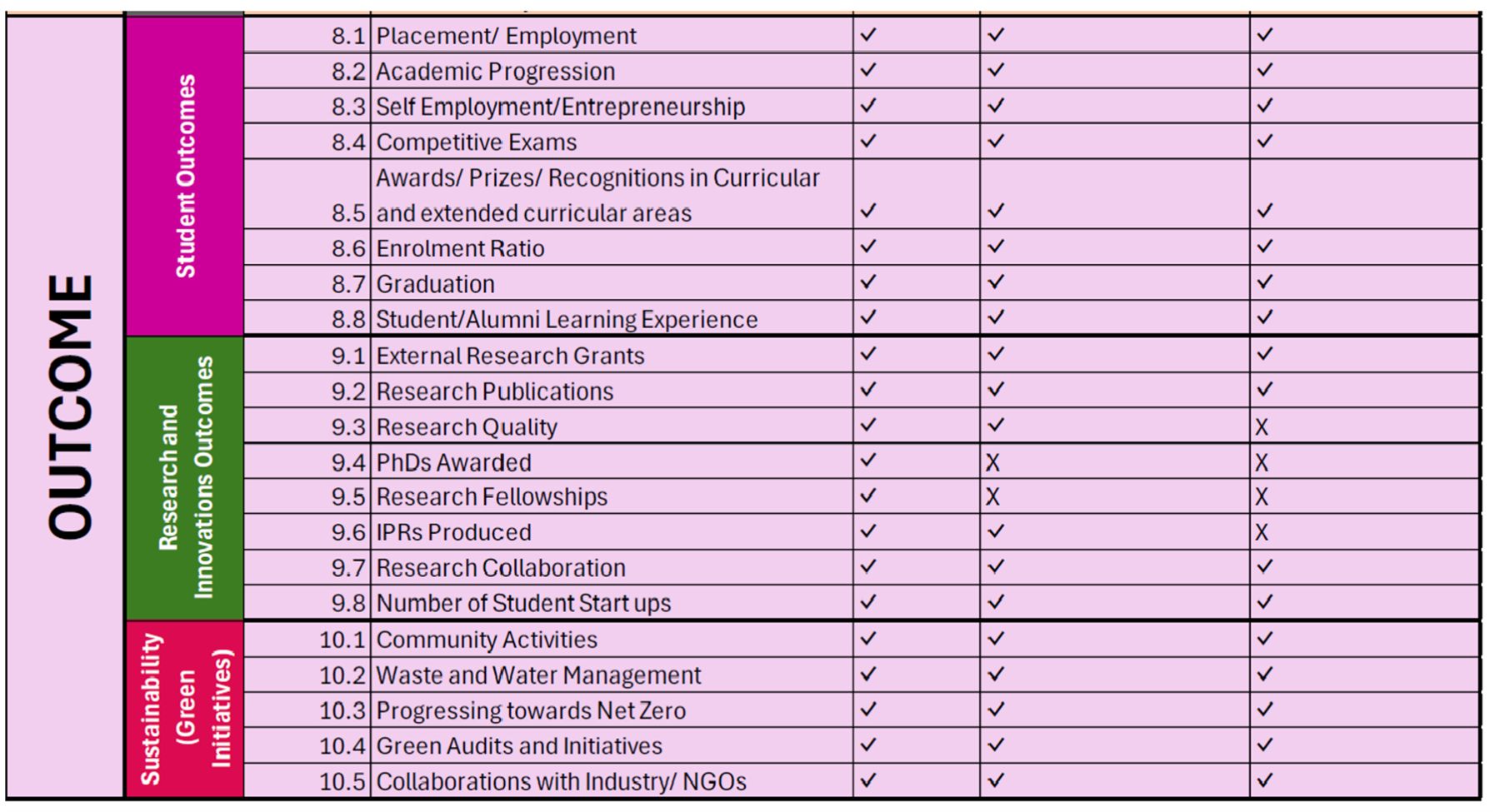
Source: supplied category images + Annexure B; preparation guidance is advisory.
Source appendix | category applicability image
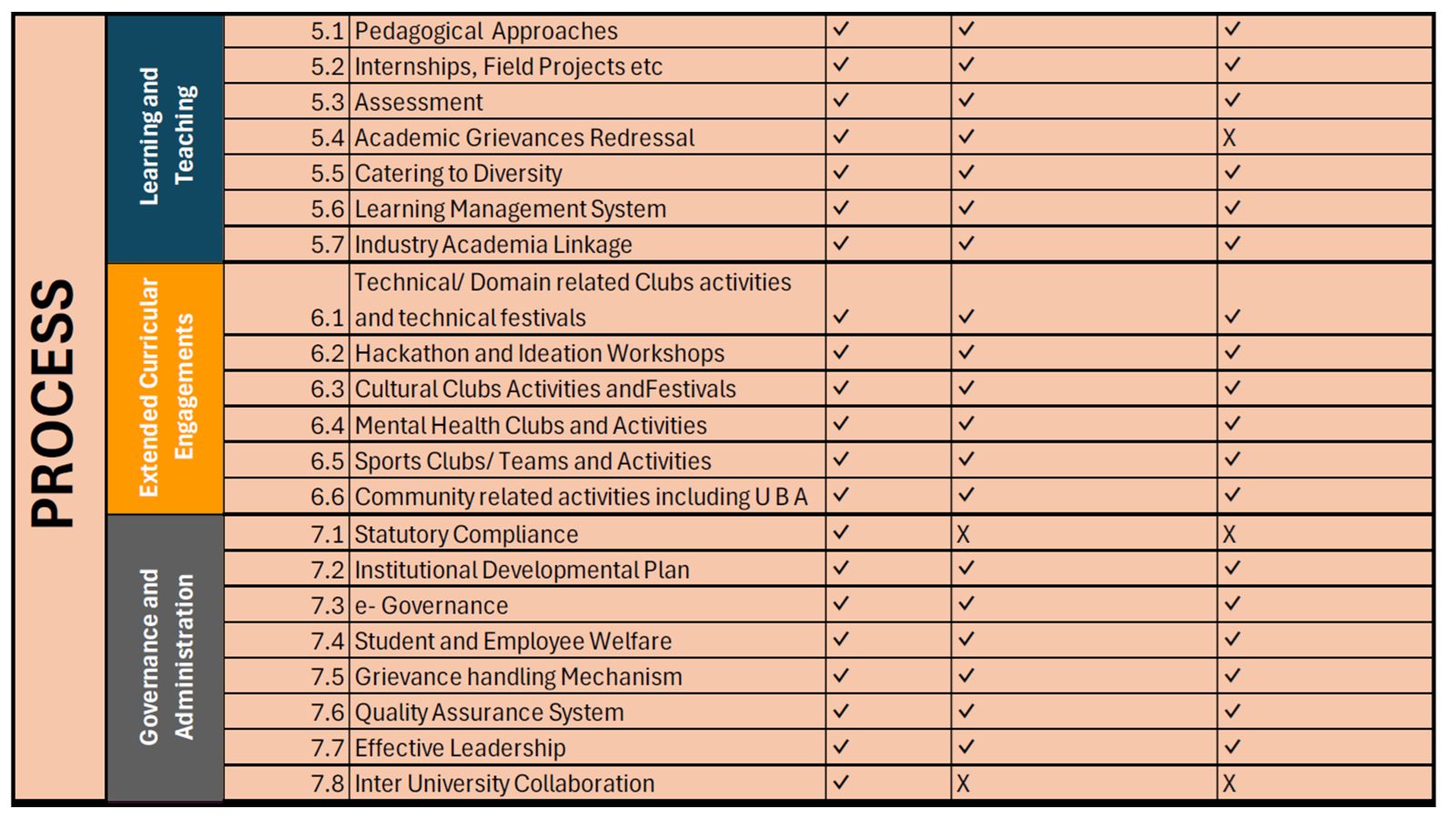
Source: supplied category images + Annexure B; preparation guidance is advisory.
Source appendix | category applicability image
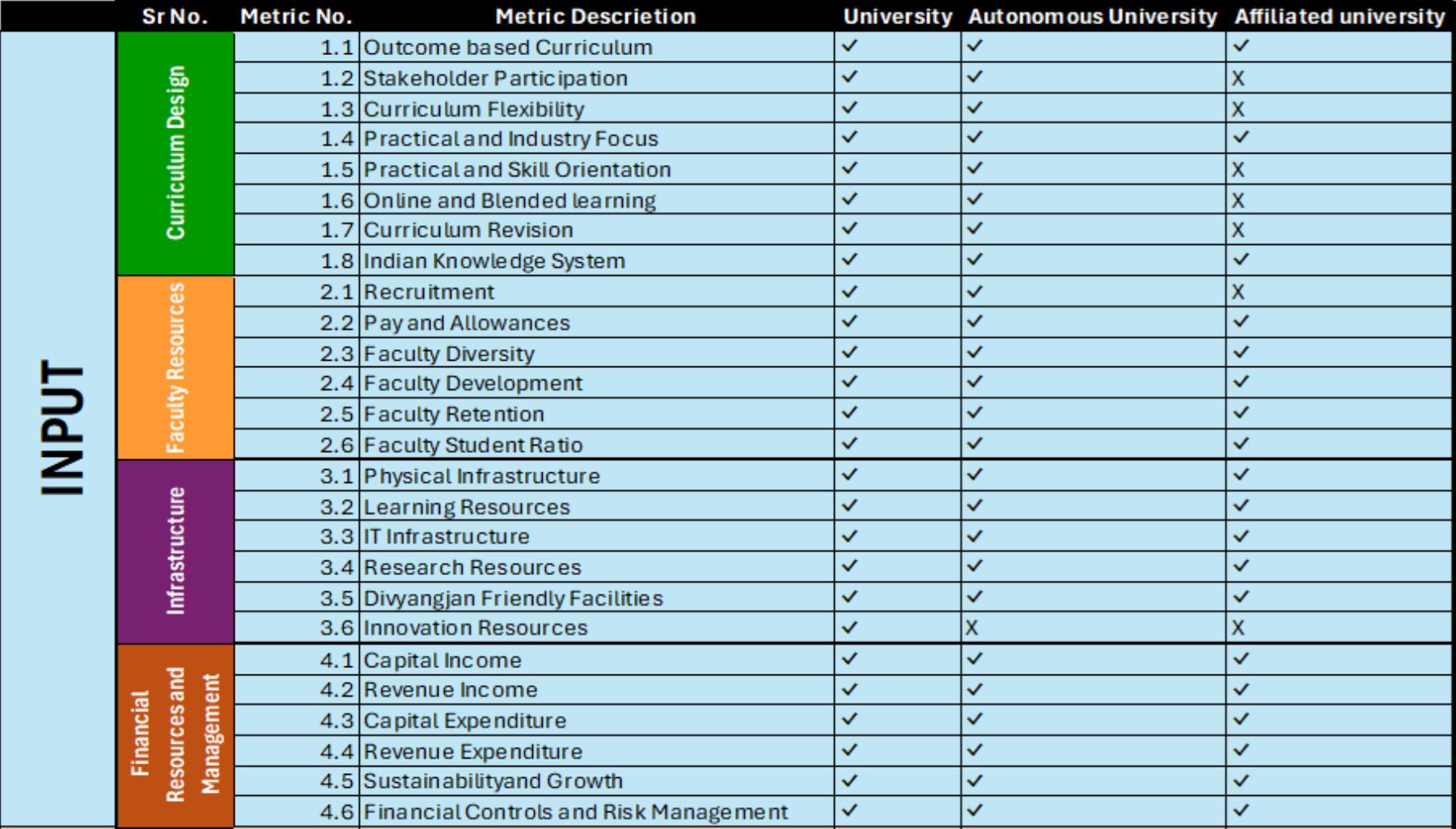
Source: supplied category images + Annexure B; preparation guidance is advisory.
Universities
NAAC 2025: Binary Accreditation
and Maturity-Based Graded Levels
What we will cover
Framework and process
Slides 3, 6–10, 12–16
Scores and attributes
Slides 20–21
Applicability
Slides 17–19 · to be added
Metrics
Slides 22–78
MBGL and strategy
Slides 80–83, 85–86 · to be added
Preparing
Roles, files, documentation: slides 87–123 · to be added
The five stages
| Stage | What it is | What you submit / receive |
|---|---|---|
| 1IIQA | Institutional Information for Quality Assessment | Eligibility data, AISHE code registered with NAAC |
| 2Digital Data Submission | Single-point data entry in DCF 2025 formats | Affiliated colleges: 46 metrics across 10 Binary attributes. NLUs / universities: 59 metrics at university scope. Optional Law discipline overlay (15 metrics + 100 score). QnM + QlM + Student Satisfaction Survey. |
| 3DVV | Data Validation and Verification | NAAC validates submitted data; clarifications cycle on quantitative metrics |
| 4PTV | Peer Team Visit | On-site assessment including departmental visits, library inspection, moot court / legal aid clinic review, stakeholder interactions |
| 5Result | Accreditation decision | Binary framework: Accredited / Not Accredited; optional MBGL Level for graded recognition |
Why a new framework
- 1
Alignment with NEP 2020
To create a transparent, technology-driven, and developmental accreditation system that is globally benchmarked.
- 2
Moving beyond 'one-size-fits-all'
Recognizing the diverse nature, size, and developmental stages of over 45,000 Higher Education Institutions (HEIs) in India.
- 3
Enhancing simplicity and credibility
Shifting from a complex, input-heavy process to a more rational, outcome-focused evaluation.
- 4
Reducing inspection-centricity
Moving towards a continuous improvement model supported by technology, minimizing reliance on high-stakes peer team visits.
A differentiated, two-stage accreditation process
Basic (Binary) Accreditation
What it is: A foundational, "Accredited" or "Not Accredited" assessment.
Goal: To ensure every institution meets fundamental quality standards. This is the first mandatory step for all HEIs.
Maturity-Based Graded Levels (MBGL)
What it is: A developmental, multi-level grading from Level 1 to 5.
Goal: For accredited institutions to assess their maturity and progress on the path to excellence. This stage is optional.
Old system vs new framework
| Feature | Previous system (pre-2025) | New framework (2025 onwards) |
|---|---|---|
| Grading | Complex letter grades (A++, A+, B, etc.) | Binary (Yes/No) + Maturity Levels (1-5) |
| Approach | 'One-size-fits-all' for all HEIs | Differentiated two-stage process |
| Focus | Input and process-heavy | Outcome-centric and developmental |
| Data source | Primarily self-reported by HEIs | Authenticated via "One Nation One Data" |
| Goal | Achieving a static grade | Fostering a continuous improvement journey |
Binary Accreditation - Highlights
Eligibility: 2 Batches graduated, AQAR Submitted
Types of Accreditation, CGPA and Validity
The pillars, metrics and scores
Input 19/12 M
- Curriculum Design (3 M)50
- Faculty Resource (5/3 M)100
- Infrastructure (5/3 M)75
- Financial Recourses and Management (5/3 M)50
Process 21/18 M
- Learning and Teaching (7/6 M)150
- Extended Curricular Engagements (6 M)125
- Governance and Administration (8/6 M)125
Output 17/11 M
- Student Outcomes (8/5 M)100
- Research and Innovation Outcomes (4/2 M)50
- Sustainability Outcomes (Including Green Initiatives) (5/4 M)75
Process / Output 15
- Uniqueness / Situatedness: 15 Discipline Specific Metrics100
2.2 Faculty Quality
Description
- A. Cadre wise faculty strength (Assistant Professor, Associate Professor, Professor…)
- B. % of teachers with doctoral degree or similar qualifications
- C. Average experience of full-time teachers (Last year teachers)
Documents
- Approved list of faculty cadre wise
- Certified list of faculty with Ph. D or equivalent (Name of University, Subject, year) per Academic year with experience in the institution
- Copies of Ph. D Certificates by UGC approved universities